

The views and opinions expressed in this article are those of the author and do not necessarily reflect the position or editorial views of the Post.
“Man’s capacity for justice makes democracy possible, but man’s inclination to injustice makes democracy necessary.”
- Reinhold Niebuhr
What does it mean to say one is serving the community? That is truly the question in today’s day and age regarding the Assyrian community here in Illinois. Today, the Assyrians of Chicago are engaged in a fundamental battle for their rights, in perhaps the only institution in the United States that we have built for ourselves.

The Institution and the People
Before examining the battle around the Assyrian National Council of Illinois (ANCI), let us take a stroll down memory lane as to why it was founded in the first place. ANCI, commonly known as Mitwa/Mutwa, was founded in Chicago in 1985¹, at a time when Assyrian immigrants were arriving in the United States in large numbers and facing the difficult task of rebuilding their lives in a new country. Its establishment followed years of discussions within the Assyrian community about how to organize, assist, and represent a people whose political, religious, and social circumstances had too often divided them.
The idea behind ANCI came as an idea not just to create a regular non-profit organization that just used the Assyrian name. It was envisioned as something that would bring the Assyrian people together regardless of our denomination, or the borders that divided us in the homeland together in one organization where we could express ourselves freely, a right that cannot be taken for granted considering the often suppressed legal rights of Assyrians in the homeland. The late Catholicos-Patriarch Mar Dinkha IV, supported such an idea², along with several city officials, who were involved in the discussions leading to the Council’s establishment. Together, with community leaders, they envisioned an organization that could address the needs of the Assyrian people collectively in the state of Illinois. Among the priorities discussed were assistance for the elderly, medical services for those in need, and educational institutions for Assyrian children, run through a body that existed in line with the democratic freedoms of the United States.
That founding vision matters. It is not simply some rosy past that we can disregard in an age of democratic backsliding across the globe. ANCIwas not conceived as the private institution of a particular family, political faction, or group of individuals. ANCI was created FOR our community, BY our community, in a country in which there is to be no kings. Today, ANCI describes its mission in humanitarian, cultural, and educational terms. Its programs have included services for the elderly, early childhood education, youth development, and the preservation of Assyrian language and culture.³ By no means does anyone oppose these goals, it is truly something to admire that after forty years, our community still works through the ANCI to preserve itself, despite constant challenges to the very existence mounted against our people.
However, words are one thing and actions are another, and if the spirit of the organization is to be protected, so must its processes. An organization that claims to serve a community must also remain accountable to that community. Being chosen to serve the community does not mean you have dominion over the people or ultimate control over their rights and destiny. This is where we meet the problem today with the ANCI. This is not some battle between two factions wrestling over control over the finances of this institution, it is not about the battle between the board president and his former vice president. It is a far more existential problem: “Who does Mutwa belong to? If Mutwa was founded for the Assyrian people here in Illinois, then the same people are not just an inconvenience in order to “simplify things”, they are a fundamental part of the institution.

Bahram v. Assyrian National Council of Illinois
The current issue with ANCI did not just come out of thin air, instead the problem began to fester when rift formed between two men of different generations. After being elected together in the 2022 election⁴, Vice President Rami Bahram and President Auger Ismail did not see eye to eye on the future of the organization. As the relationship soured between the two, it became apparent the Auger, along with his allies on the board would seek the removal of Bahram, however this spilled into years of litigation in the Circuit Court of Cook County, exposing a much larger question: are the Council’s governing rules binding on its leadership, or can those rules be set aside when they become inconvenient?
According to Bahram’s complaint, the Board sought to remove him without following the procedures established in the organization’s governing documents. Those procedures included two written warnings and an opportunity for the Board member to rehabilitate his standing before removal proceedings could move forward. Bahram alleged that he received neither the required warnings nor the opportunity to address the grounds for his removal.⁵ He further challenged the Board’sactions at meetings held in June and July 2023. ANCI and its President, Auger Malik Ismail, disputed his allegations in their court filings.⁶ The dispute therefore became more than a disagreement over personalities: it required the court to consider the relationship between the Board’s authority and the rules that governed its exercise.
On October 8, 2026, the Hon. Judge Alison C. Conlon issued an order on summary judgment in Case No. 2023CH9668. The court declared that Bahram had not been removed from the ANCI Board for cause I naccordance with Article 4, Section 12. Consequently, he was not barred under Article 4, Section 14 from seeking election to the Board or holding positions within ANCI on the basis of a for-cause removal under that provision. The court did, however, make clear that this declaration did not exempt Bahram from any other eligibility requirements contained in ANCI’s Constitution and Bylaws.⁷ The implications extend beyond one Board member. The court’s order reinforced a basic principle of organizational governance, by making it clear that the board must follow the procedures that give them their authority. The court further commented that according to the by-laws an election was to be held in a window allotted by said by-laws, and that Mr. Bahram would be able to stand in such an election.⁸
The question to the Board became, how can we respond to such a loss?If the board believed it was in the right, then why would there be fear of an election or the processes that should be followed? Instead, the board decided to take a court of action that I can only characterize as spitting in the face of the same people who elected them, all in a clear attempt to hang onto power.
The Fight Over Membership and Democracy
The Board of ANCI spent the following month pondering ways to continue its agenda, which will be addressed later in this article. The best idea they could come up with was the age-old strategy of the child who lost a playground game, by taking their ball and going home. Except in this case the ball is the democratic rights of the Assyrian people, and going home is keeping the rights of the organization vested solely in the board, the same board who only gained their legitimacy through democratic election.
To understand the magnitude of their decisions, one must look at the August 1, 2021 Constitution and Bylaws of the ANCI and the replacement bylaws passed on November 4, 2026.
The 2021 Constitution begins with a preamble that makes theorganization’s intended purpose clear. It describes the need to organize the Assyrian community through a democratic process to establish a legitimate institution capable of serving its community.⁹ It sets a vision in which the representatives are elected from the community, in order to truly represent their interests.
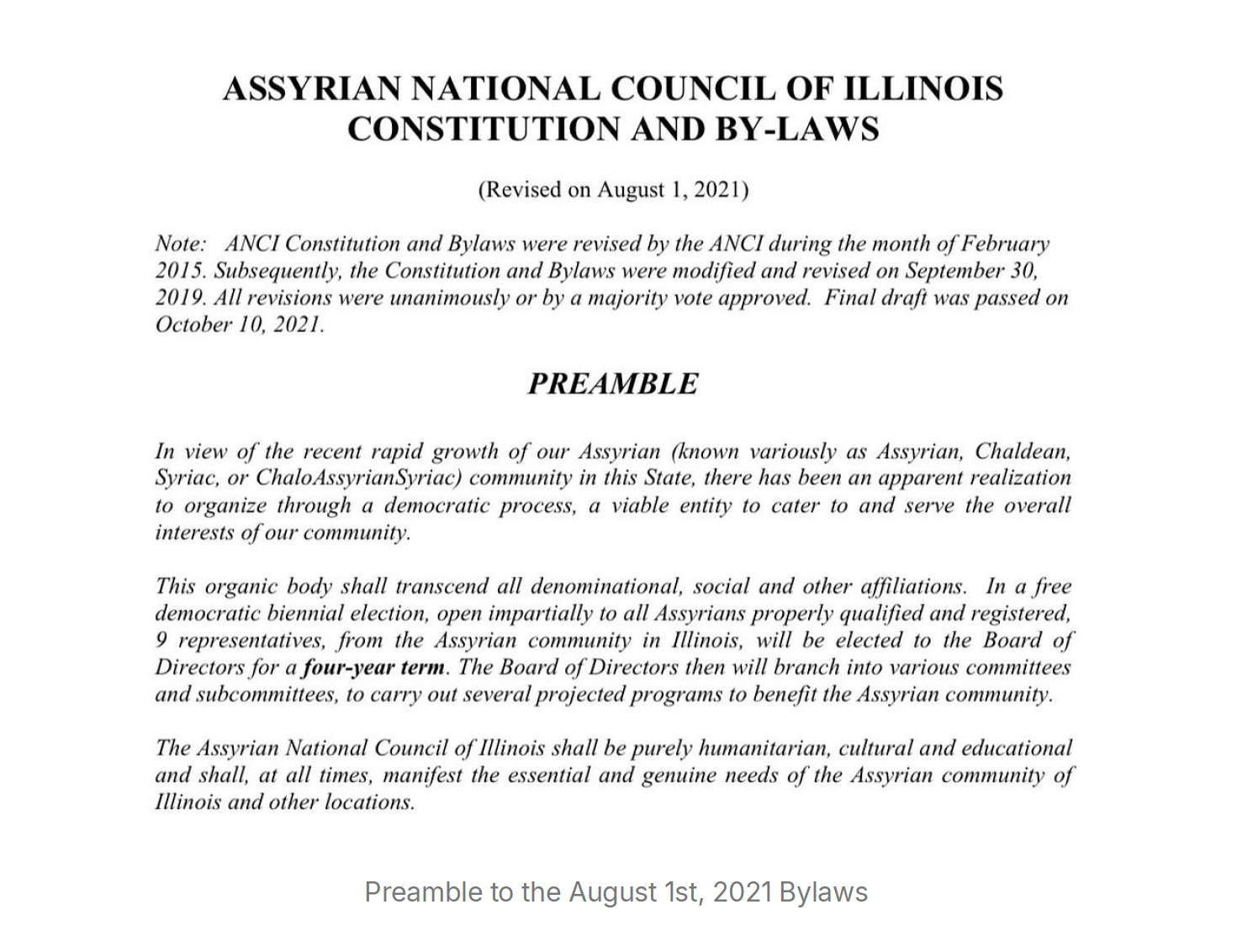
This isn’t some sort of vague language that we need to stretch the truth in order to achieve our desired meaning, since ANCI also had a forty-year history of elections! That is what we like to call a precedent. Article 4, Section 2 of the same constitution expressly states that members of the Board of Directors shall be elected by a majority of the Illinois Assyrian community at large.¹⁰ This tells us that the Board’s election is the responsibility of the people, it bequeathed to them a democratic right and a responsibility. Article 1, Section 3 further adds to this point by defining what it is to be an Assyrian. Stating that the term Assyrian refers to those identifying as Assyrian, Chaldean or Syriac as for the purposes of the document, thus providing further definition for the people who consist of the elective body of the organization.¹¹
This is the basis of what can be described as the legal concept of "constructive membership”.¹² The 2021 by-laws do not have a membership category or set a price in order to achieve membership. Instead, the document tells us who can vote, and on what basis, something that in typical organizations such as ANCI is a right reserved only for members. Without using the word membership, the by-laws tell any trained eye who the members are, the Assyrian community of Illinois! The community’s job as the members is not just one in which that is passive, instead we are instrumental in selecting those who govern, and in the same way we are required to hold them responsible in the protection of our rights.
The November 4, 2026 bylaws decide to take this principle, crumple it up and throw it in the garbage, as if that is what can be done to the rights of members. Article 4 of this dictatorial document states plainly: “The Corporation shall have no members.”¹³ Now, why would the Board choose to explicitly create such language in the new by-laws? Is it because the previous by-laws created a class of membership defined as the entire community? Almost certainly, hence the need to introduce their new language, to extinguish the democratic right of the people.
Contrary to what the current board would want you to believe, they DO NOT have the legal right to do this. Under 805 ILCS 105/110.15, directors may adopt amendments by majority vote where the corporation has no members or no members entitled to vote on amendments,¹⁴ however this is not the case with ANCI, an organization with a democratic history. Furthermore the 2021 Constitution expressly provides in Article 13 that Robert’s Rules of Order (a handbook for how organizations such as ANCI can be governed), shall govern matters not covered by the bylaws.¹⁵ If the 2021 Constitution expressly identifies the Illinois Assyrian community at large as the electorate and the members, the Board cannot simply just take unilateral power to erase the rights allotted to them. Section 25:11 of Robert’s Rules addresses the protection of fundamental rights belonging to individual members. It recognizes basic membership rights including the rights to attend meetings, make motions or nominations, participate in debate, receive required notice, and vote.¹⁶ These cannot simply be suspended through actions taken solely by the board. These protections exist precisely because an organization’s governing body should not possess unrestricted authority to deprive its members of their fundamental rights. These were created in order to protect the members (the community of their rights), making the rights an obligation to ANCI not just a privilege that they can strip when they please.
So what replaces the general election? Well the board spelled it out for us in what they believe the new by-laws are and in subsequent interviews. The 2026 by-laws state the board is to consist of no fewer than six and no more than ten directors, and directors are elected by the Board at a special, regular, or annual meeting.¹⁷ In other words, the community does not vote for its representatives. The sitting Board chooses who joins its ranks. And if anyone was still unsure about how this process would work in practice, President Auger Ismail offered an explanation in his November 21, 2026 interview. He described a process in which interested candidates submit applications to the Board, and the Board votes on those applicants. He referred to that process as an“election.”¹⁸
Perhaps it is an election in the narrow sense: there is a vote, and someone is selected. But an election without the electorate isn’t really democracy is it? Instead it is a system reminiscent of politics in Ba’athist Iraq and Syria, the same countries Assyrians fled from seeking the freedoms and right to democracy allotted to us here in the United States. A system in which the board gets to select amongst itself who can join their exclusive clique, or perhaps choose to remain in perpetuity until someone runs afoul of the dominant party or in the event of the passing of a board member.
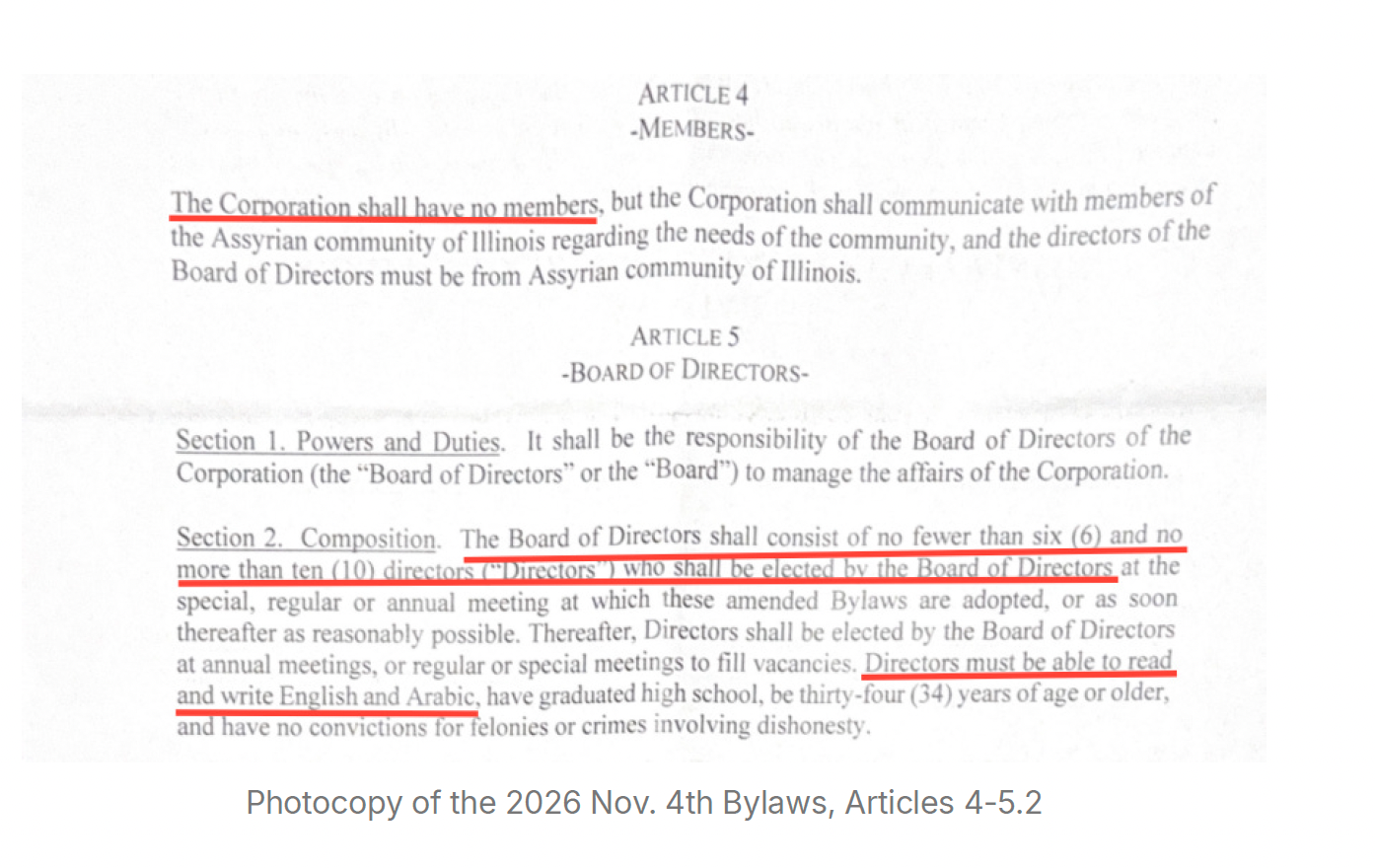
This isn’t the only peculiar change, the November 2026 bylaws introduce additional specific qualifications for anyone seeking a position on the Board. Candidates must be at least 34 years old, possess a graduate degree, and be able to read and write in English, but also strangely Arabic fluency is required.¹⁹ Are Assyrians an Arab people, do we not have our own language? For an institution that claims to want to preserve Assyrian heritage, the need to include Arabic (a secondary language of some Assyrians in the homeland) with no mention of the Assyrian language is a puzzling one. Furthermore, how is such a thing not discriminatory to the thousands of Assyrians who hail from the modern state of Iran or Turkey, where their secondary language isn’t Arabic. Must they learn Arabic to serve in an official capacity? What about the young men and women of our community, many of whom are qualified with college degrees and a hunger to serve, must they also learn Arabic to be of use to the ANCI, the vehicle dedicated to serving the Assyrian community?
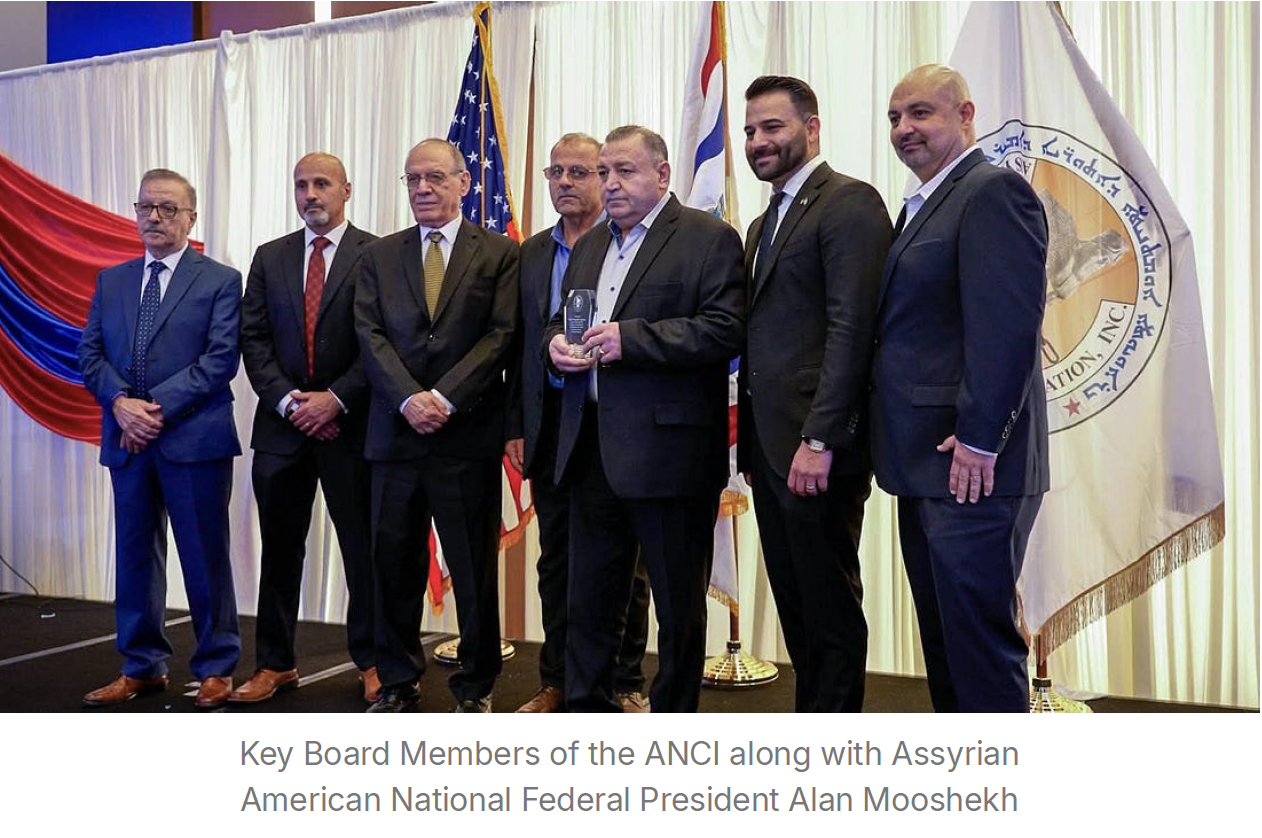
One thing is clear via this move, this was not made to create a stronger board of the ANCI but instead it is qualifications tightly knitted around the needs of the current board, specifically to preserve power in the generation of people who immigrated here rather than the future of our community. Interestingly enough, a quick glance at the qualifications could almost lend one to the thought the board specifically thought of their opponent in litigation, Mr. Rami Bahram when concocting such a scheme. It was almost as what spurred these changes was an attempt to go around the order of Judge Conlon, following the train of thought of “If the court says Mr. Bahram is allowed to run, let us just remove elections entirely.” A train of thought that could be seen by some as a violation of the judge’s order. However I am sure the legal system will rule on this in due time.
And since Arabic is now apparently a requirement for anyone seeking a seat on the Board, perhaps we should give this new electoral process an appropriate Arabic name: واسط†(Wasta). After all, when the community no longer chooses its representatives and candidates must first pass through the Board’s approval process, one might reasonably wonder whether qualifications and democratic choice have been replaced by connections and influence. Perhaps the next revision should simply rename the election committee the وزار†الواس†(Wazirat Al-Wasta).
ANCI would like us to believe that those opposing them are trying to shut down the educational programs for the youth, or the sports programs, but this is completely out of left field. No person has made such claims or demands besides ANCI themselves in a sad attempt to smear the democratic opposition. If anything, the opposition is attempting to preserve those programs by keeping them in the hands of the community and not in the hands of those who deem themselves worthy to sit on a throne indefinitely.
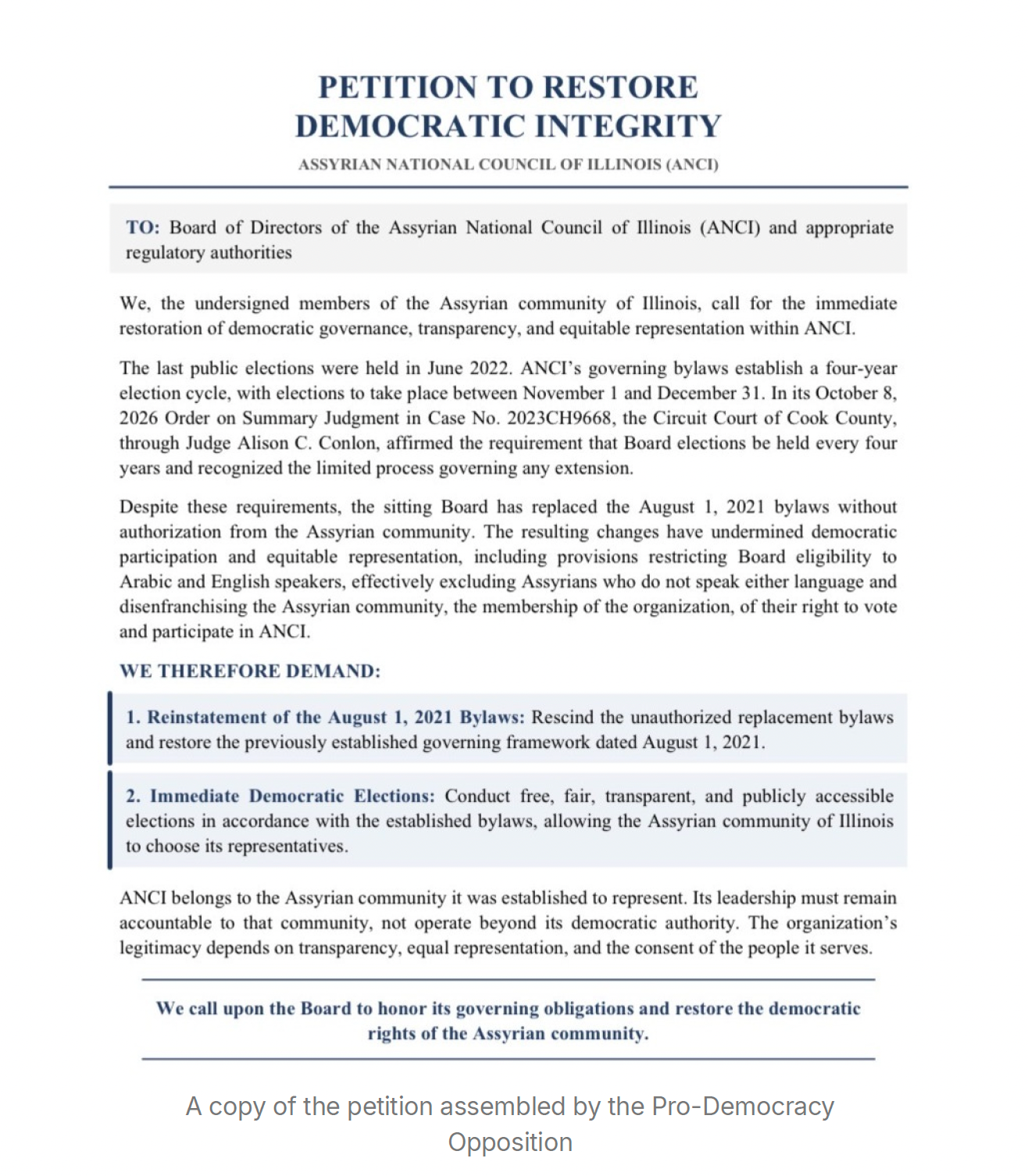
So how has the community chosen to respond to the stripping its rights? Well, with civility of course, rooted in a strong belief in the judicial process. A petition was drafted, and signatures have been collected (and are still in collection) from the Assyrian Community of Illinois²⁰. The current number of signatures gathered has exceeded the amount of total votes in the last election, which should say quite a bit about the opinion of the general public on this matter. The leaders of what we might call the “Democratic movement”, are exhausting every path available to them in order to avoid potential litigation, something that can only hurt the community.
A proposed compromise has also been put forward: a joint election committee consisting of three representatives appointed by ANCI and three representatives selected by the community. Such an arrangement would allow both sides to participate in organizing an election while providing a measure of shared oversight and confidence in the process.
The issue is not whether or not ANCI can do such a thing, the issue is whether the Assyrian community at large is willing to let them get away with it. The 2021 Constitution described a Council whose representatives would be chosen by the Assyrian community. The November 2026 bylaws describe a Council in which the Board chooses its own directors. These are polar opposite visions for the same institution, one which plainly says this institution is the Assyrian community’s, and another in which it declares it shall remain in the hands of those who presently wield it. If the people no longer hold a stake in the institution, can it truly be said to be the same organization that was founded by His Holiness Mar Dinkha and the leaders of our community the 1980s?
Follow The Money
If the question is who controls the Assyrian National Council of Illinois, the next question should be just as obvious: Where does the money go within this organization?
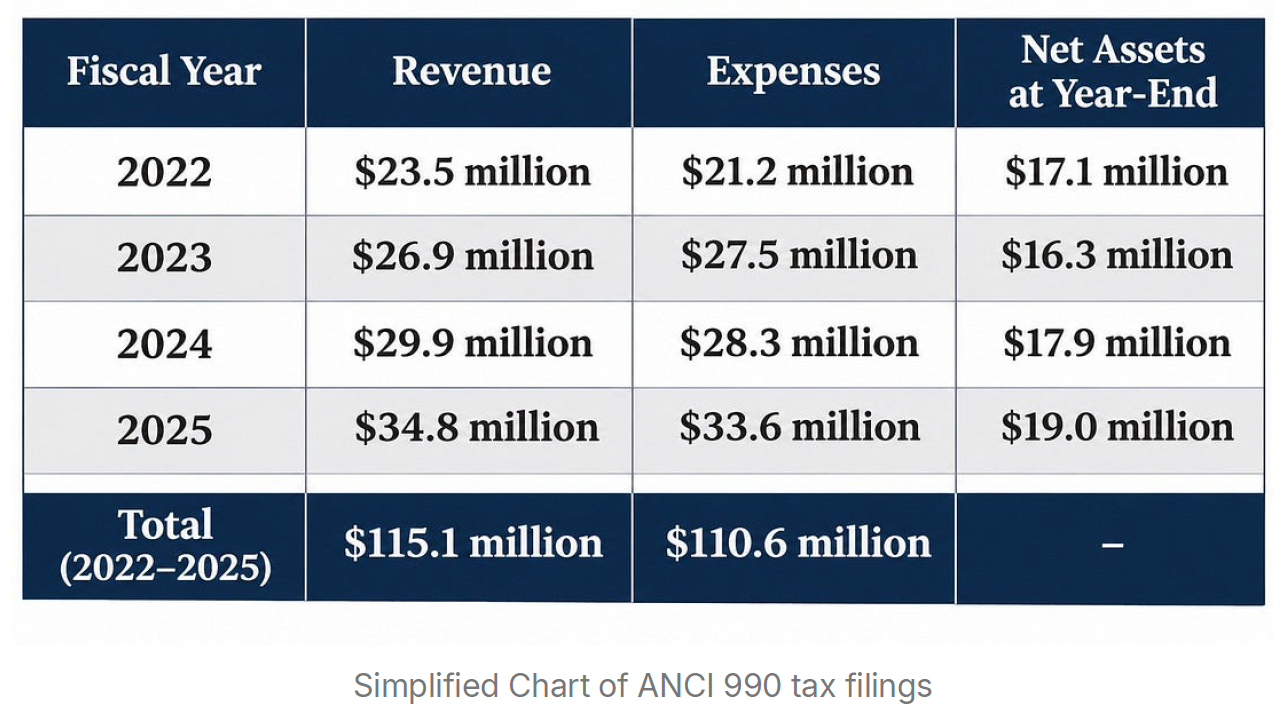
ANCI is not a small neighborhood association operating on bake-sale proceeds and membership dues. Its own federal tax filings show an organization handling tens of millions of dollars annually mostly due to its home-care operation and banquet hall operation. Between 2022 and 2025, ANCI reported approximately $115.1 million in total revenue and more than $110.6 million in expenses. Its annual revenue increased from$23.5 million in 2022 to nearly $34.8 million in 2025. At the end of that period, it reported approximately $19 million in net assets. All filings and numbers are available in the footnote.²¹
These are substantial resources. And with substantial resources comes an equally substantial responsibility to explain how they are used. The Council’s mission is to serve the Assyrian community, not simply to accumulate assets or distribute grants without meaningful public scrutiny. The community has every reason to ask where the money goes, who receives it, and who makes those decisions.
The Form 990 filings provide some answers, but they also raise questions worth pursuing. One recurring recipient is the Assyrian Aid Society of America (AASA), a well-known Assyrian organization with close ties to the Assyrian Democratic Movement (ADM) also known as Zowa’a. According to ANCI’s filings, grants to AASA totaled approximately $1.48 million between 2022²² and 2025²³.
2022: $319,130
2023: $635,955
2024: $437,439
2025: $88,091
Now, I am not calling into question the good work that Assyrian Aid Society does, however with such a vague purpose for foreign projects, is there any ability to trace exactly where ANCI’s funds are going? Which specific projects were assisted with ANCI funds, or is this just an attempt to go around the restriction on a non-profit sending money to foreign political organizations? The question has a right to be asked.
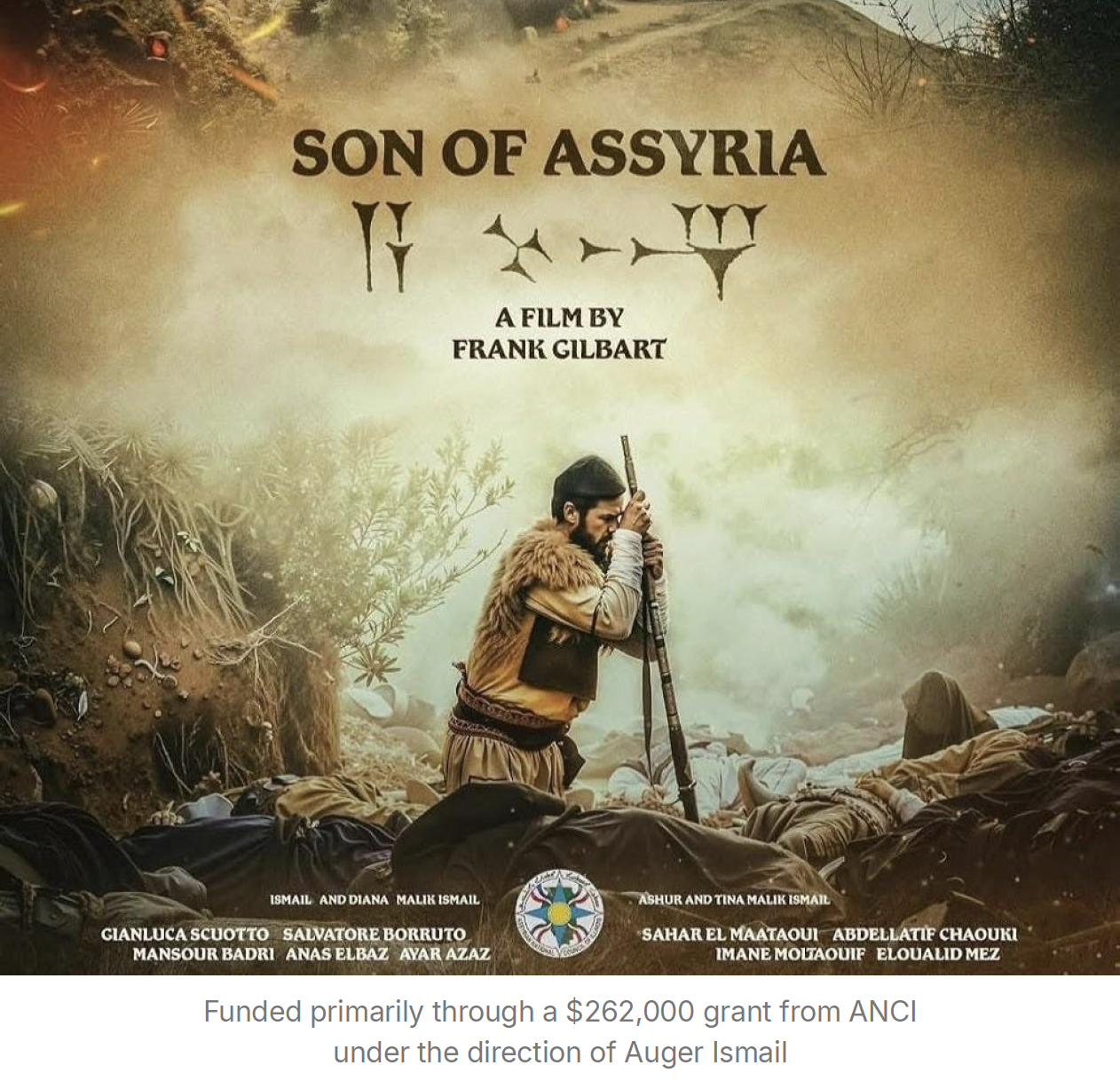
The same scrutiny should apply to domestic grants. The 2025 filing, for example, identifies a $262,000 grant to FG Productions.²⁴ The stated purpose was to support efforts to preserve films that capture and celebrate Assyrian culture. That makes it one of the largest individually identified grants in the filing. Now with further context we can see that this grant was sent to Assyrian director Frank Gilbart, for his 2025 film Son of Assyria, a noble endeavor indeed, but even this transaction has questions. The film was about Malik Ismail’s life story, Malik Ismail being an Assyrian leader in the 19th century, and an ancestor of the President of the board, certainly something that could be classified as a conflict of interest under any understanding of the principle. Such an amount warrants questions, Who determined the amount? Did the President participate in proposing, negotiating, or approving the grant? Was any relationship disclosed to the Board? Did he recuse himself from the decision? Was the grant approved by disinterested directors? Or is this an early hint at the واسط†(Wasta) system that was to come in 2026?
These are ordinary questions of nonprofit governance. They are not accusations of wrongdoing. But when a substantial grant is connected to a project reportedly involving the President’s family history, the public should not be expected to accept a one-line description as the entire explanation. And this is not an argument that ANCI should stop funding cultural, religious, or humanitarian projects. Quite the opposite. These are precisely the kinds of activities an organization established to serve the Assyrian people should be supporting. The issue is whether those expenditures are made transparently, with appropriate oversight, and according to the interests of the community rather than the preferences of individuals holding office.
An organization who owes duty to the general public should be as transparent as possible when spending money earmarked for the Assyrian community. We are no longer in an age where spending needs to be hidden in the shadows, this needs to be understood by all.
The Politics We Brought With Us
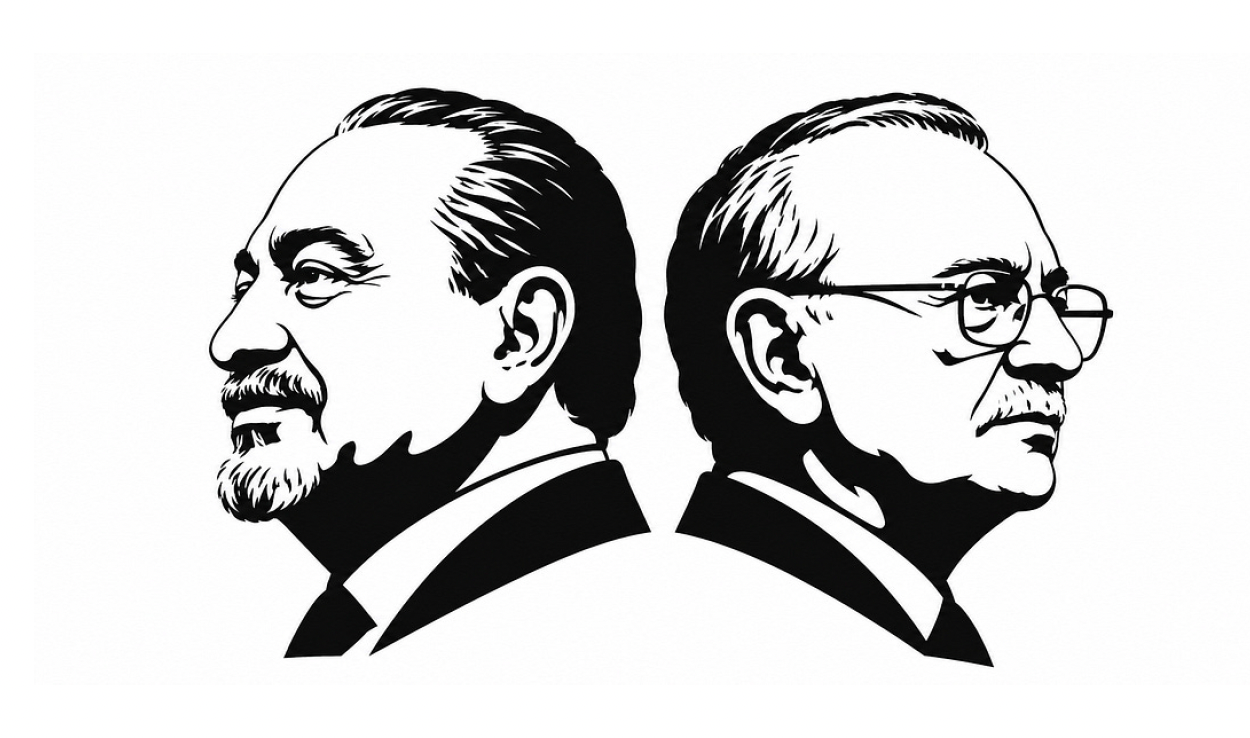
The ANCI was founded to be a non-political organization, one meant to serve the community at large regardless of their politics… Unfortunately, the politics of the homeland have a way of following us across the ocean.
There are legitimate questions about the political relationships that exist between the current board and political activists here and abroad. I understand that relationships with politicians are necessary for such work, as they are fellow leaders in the community, whether or not you agree with them. However when personal relationships, political associations, overseas visits, and the distribution of charitable funds begin to overlap, the community is entitled to ask questions.
Consider the family connection between President Auger Ismail and Younadam Kanna. Kanna is a prominent political figure whose influence in Assyrian political affairs is well known, he requires no introduction. There is also the role of board member Hermiz Tiro, who has been known as a longtime ally of Kanna in Chicago. These relationships do not by themselves establish that ANCI is taking direction from any political figure. They do, however, make transparency about political influence and institutional independence especially important.
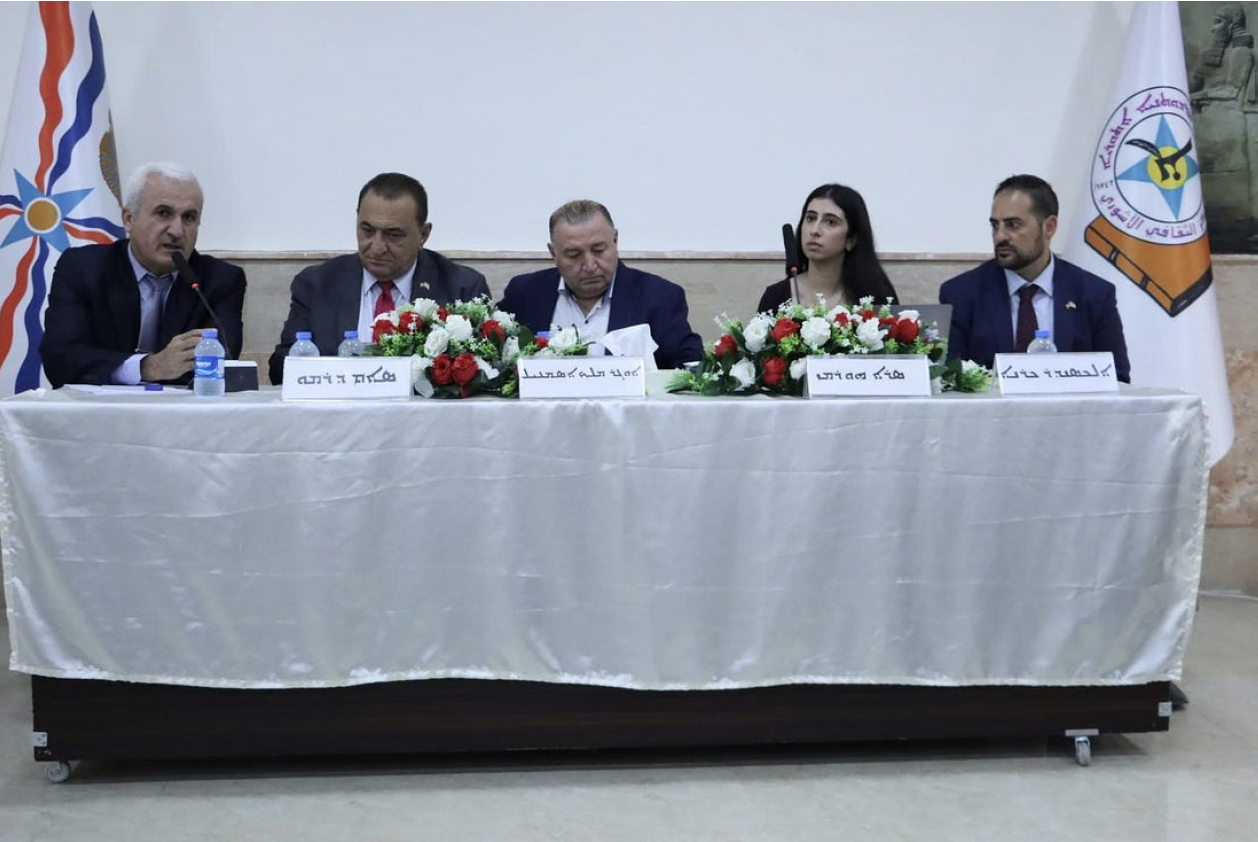
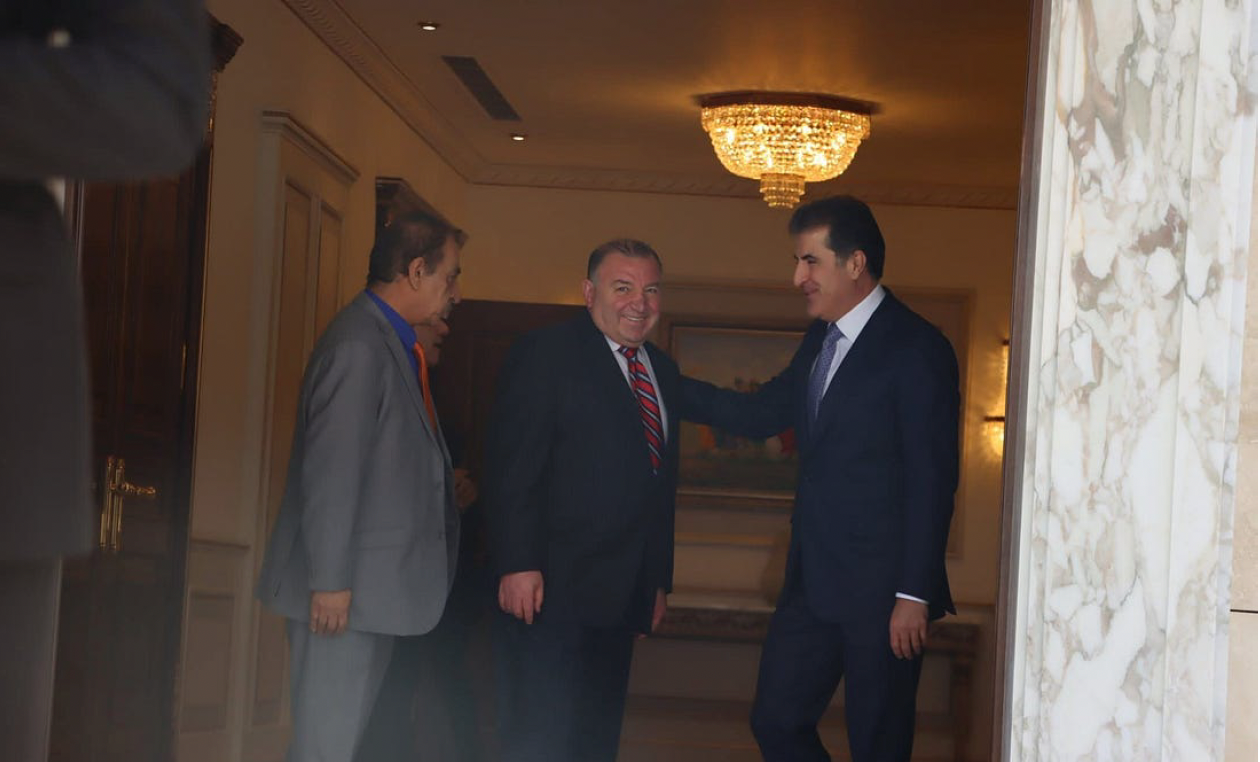
The same questions arise when looking beyond Illinois. In September 2025, Auger Ismail traveled to northern Iraq alongside Sam Darmo, an outspoken ally of the Kurdish KDP party and the Barzani political establishment. Again, a trip is not proof of wrongdoing. Assyrian leaders and community representatives will naturally meet political figures and travel to the homeland. The question is what capacity they are acting in, whom they are representing, and whether those relationships have any bearing on the board’s decisions.
That question becomes particularly relevant when considered alongside ANCI’s financial records. Its 2025 Form 990 lists a $25,000 grant to Assyrians for Justice ²⁵, an organization solely associated with Sam Darmo. The filing identifies the recipient and the amount, however it gives no context as to the purpose of the funds or if they had any connection to the 2025 trip. What was the grant intended to fund? Who proposed and approved it? Were any relevant relationships disclosed? What work was completed with the money?
There is a larger principle at play here. ANCI is not a political party, a campaign organization, or a vehicle for advancing the interests of any particular faction. Its stated purpose is to serve the Assyrian community. That means its leadership must be able to demonstrate that decisions are made in the interest of the institution and the people it serves, not according to personal loyalties or political friendships.
Assyrians know what happens when political factions become more important than the people they claim to represent. We have spent generations dealing with political parties, governments, and movements that have claimed to speak on behalf of our people while leaving our people with no voice. Such dynamics should not be recreated here in the United States, the Assyrian people do not need to tolerate these practices any further. An organization created to unite the Assyrian community cannot afford to become another arena for imported political rivalries. We have enough of those already.
The People v. Mutwa
At the end of all this, the question is rather simple: who does the Assyrian National Council of Illinois belong to?
Is it an institution belonging to the Assyrian people, established to represent their interests, preserve their heritage, and serve their communities? Or has it become an institution belonging to the individuals who happen to control its Board?
The answer is clear, ANCI was not established to be a private club, a political extension of any faction, or a permanent seat of authority for whichever group manages to occupy its offices. It was built on the premise that the Assyrian community needed an institution capable of bringing people together across denominational and political divisions via a democratic format. The ANCI’s legitimacy comes from those same people who it claims to serve and represent. The changes introduced in November 2026 are a contradiction to those values. The 2021 Constitution and every prior iteration before that going back to 1986 envisioned an organization whose directors were elected by the Assyrian community of Illinois. The new bylaws declare that the Corporation has no members and that power solely rests in the Board itself. Whatever terminology is used to defend this arrangement, the practical result is clear: the community has lost its direct role in choosing the people who govern its institution.
The Assyrian National Council of Illinois belongs to the Assyrian people here in Illinois. Its leadership is temporary, people come and go. Its mission is not. And no board, regardless of who sits on it, should ever confuse the two. This was never supposed to be about who gets to sit at the head of the table. It was supposed to be about the people gathered around it and how to do right by them.
Pithyou Mazarnaya is an Assyrian-American from Chicago who has been an active community member for several years, he also retains an insight into organizational and business law in the United States. He has published on Substack in the past.
Notes
- Our Story, https://ancil.org/about-us/
- His Holiness Honored by Assyrian National Council,” Assyrian Church News,Jan. 28, 2011, https://news.assyrianchurch.org/his-holiness-honored-by-assyrian-national-council/
- Assyrian National Council of Illinois, “Programs & Services,”https://ancil.org/
- Assyrian National Council of Illinois, Constitution and By-Laws 1, 4–5 (Aug. 1,2021)
- Assyrian National Council of Illinois, Constitution and By-Laws art. 4, § 12(E) (Aug. 1, 2021)
- Bahram v. Assyrian National Council of Illinois, No. 2023CH9668 (Cir. Ct.Cook County)
- Bahram v. Assyrian National Council of Illinois, No. 2023 CH 9668, OrderGranting Plaintiff's Amended Motion for Partial Summary Judgment (Cir. Ct.Cook County Oct. 8, 2026)
- Id.
- Assyrian National Council of Illinois, Constitution and By-Laws 1 (Aug. 1,2021) (Preamble)
- Id. art. 4, § 2.
- Id. art. 1, § 3.
- Id. at 1 (Preamble); art. 4, § 2.
- Assyrian National Council of Illinois, Amended By-Laws art. 4 (Nov. 4, 2026)
- 805 Ill. Comp. Stat. 105/107.03 (2026); 805 Ill. Comp. Stat. 105/110.15 (2026)
- Assyrian National Council of Illinois, Constitution and By-Laws art. 13 (Aug.1, 2021)
- Henry M. Robert III et al., Robert’s Rules of Order Newly Revised § 25:11(12th ed. 2020)
- Assyrian National Council of Illinois, Amended By-Laws art. 5 (Nov. 4,2026).
- https://www.facebook.com/share/v/1A9C7ZN4Fh/
- Assyrian National Council of Illinois, Amended By-Laws, director eligibilityprovision (Nov. 4, 2026)
- “Petition to Restore Democratic Integrity,” Assyrian National Council ofIllinois (2026)
- https://projects.propublica.org/nonprofits/organizations/363458487
- Assyrian National Council of Illinois, IRS Form 990, tax years 2022 and2023, Schedule I, Parts I–II
- Assyrian National Council of Illinois, IRS Form 990, tax years 2024 and2025, Schedule I, Parts I–II
- Assyrian National Council of Illinois, IRS Form 990, tax year 2025, ScheduleI, Parts I–II
- Assyrian National Council of Illinois, IRS Form 990, tax year 2025, ScheduleI, Parts I–II


