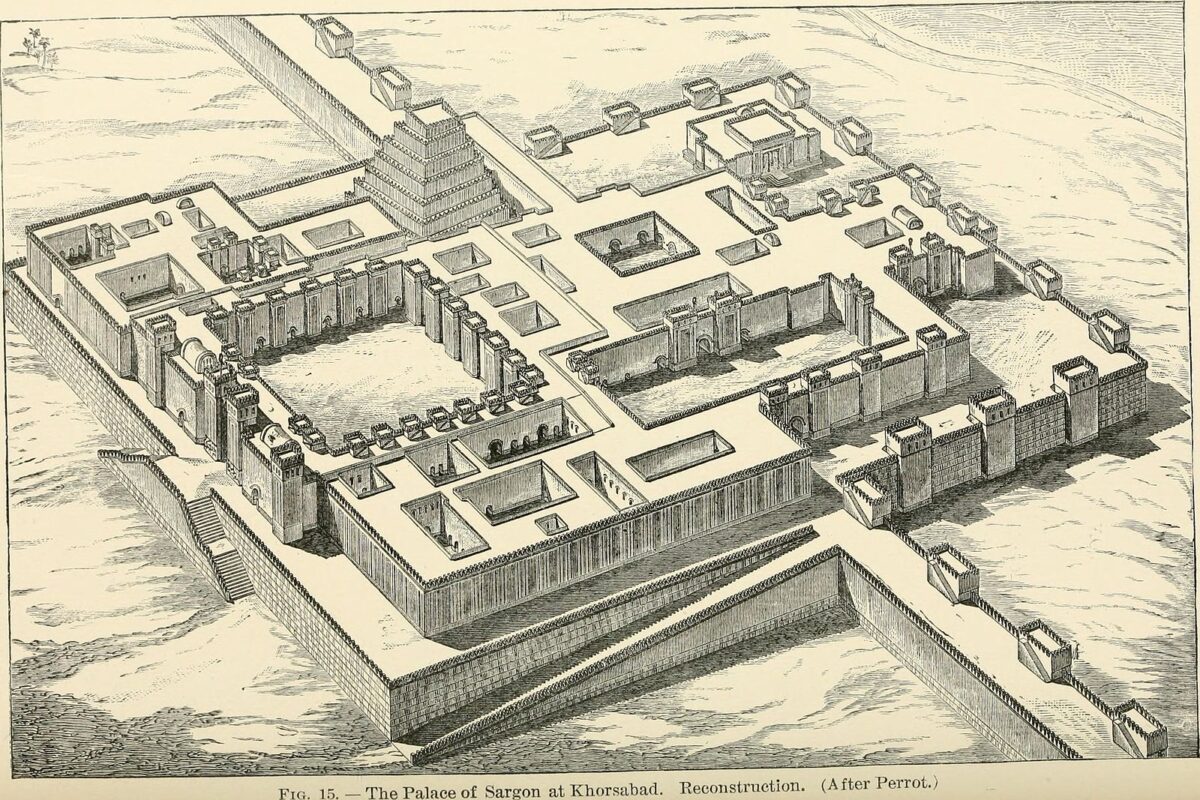
Villa twice the size of the U.S. White House revealed at ancient Assyrian capital
A magnetic survey at Khorsabad, once the ancient Assyrian capital, has revealed the remains of a huge villa (with 127 rooms), royal gardens, the city’s water gate and five large buildings.
"The site, dating back 2,700 years, was originally established as Dur-Sharrukin, or “Fortress of Sargon,” by Neo-Assyrian Emperor Sargon II in 713 B.C.
The Neo-Assyrian emperor Sargon II began building a new capital city, named after himself, in the desert of what is now Iraq. For a long time, archaeologists believed that this ambitious project had only just begun when it was abandoned, leaving behind nothing but the remains of a building site. However, a recent survey of the site challenges that notion. The city did indeed flourish outside the palace, as evidenced by visualizations of data from a precision magnetometer that reveal hitherto undiscovered structures and infrastructure inside the city walls.
Sargon II died a few years after work began on Dur-Sharrukin (“Fortress of Sargon”), now called Khorsabad. His son quickly set up his own capital in the city of Nineveh, and for the next 2,500 years, Sargon II’s building project was largely forgotten. In the 1800s, French archaeologists rediscovered the site."
In a personal reflection, Assyrian-American student Sabrina Bet-Mansour draws on her family’s history of displacement and migration to examine today’s immigration policies and the growing challenges faced by those fleeing violence and persecution.
On August 7, 2026, Assyrian communities around the world observed the Day of Remembrance for Assyrian Martyrs. On this day, the victims of persecution and mass killings are commemorated, particularly those who perished during the Simele massacre in Iraq in 1933.
The best cookbooks offer more than recipes—they tell the stories of the people behind them, their heritage, and their struggles. That’s exactly what makes The Oldest Kitchen in the World by Matay de Mayee such a treasure.
New details from the Ottoman population register, which records the 1835 census in the city of Mardin, provide a precise breakdown of the city's households, showing that Assyrians made up the largest non-Muslim group.
Randy K. Abro, a 41-year-old Assyrian man from Utica, Michigan, was fatally shot at a warehouse and business plaza in Sterling Heights on October 7. A Detroit man has been charged in connection with his death, while authorities continue searching for a second suspect.


 Leman Altuntaş