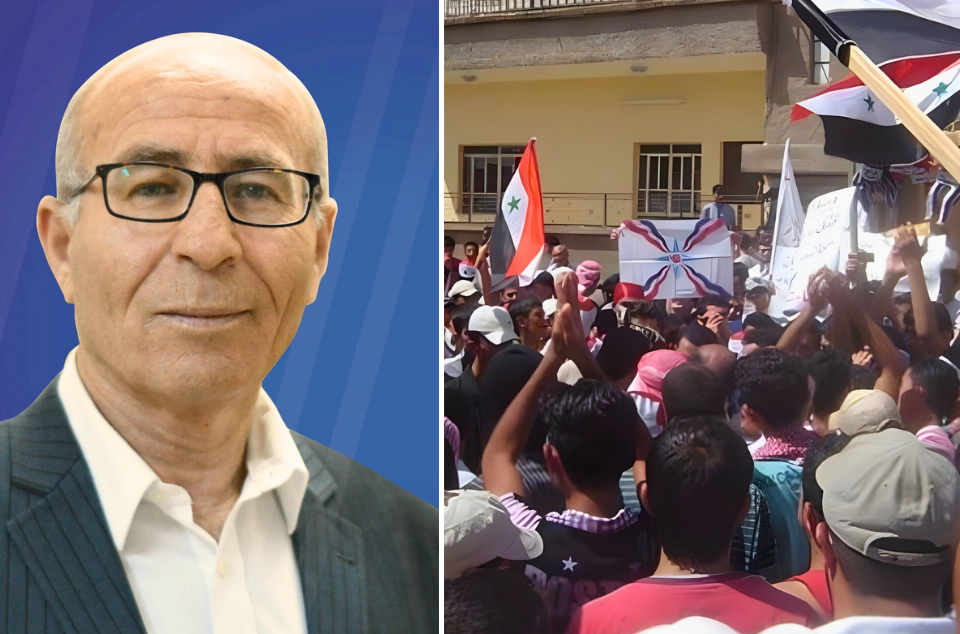
Gabriel Moshe appointed to Syrian parliament on president's list
The names of the members of Syria's new People's Assembly selected by President Ahmad al-Sharaa under the "President's List" were announced in Damascus earlier today. Among those appointed is Gabriel Moshe Kourieh, an official of the Assyrian Democratic Organization (ADO).
The President's List includes 70 individuals representing Syria's various provinces and communities as part of the formation of the country's new People's Assembly.
Moshe is a well-known Assyrian political figure and longtime member of the Syrian opposition. He was imprisoned by the government of former President Bashar al-Assad because of his political activities and has held several senior positions within the Syrian opposition.
Among his most prominent roles, Moshe served as the Assyrian Democratic Organization's representative in the General Secretariat of the Damascus Declaration, a member of the Syrian Negotiation Commission, and a member of the Syrian Constitutional Committee.
His appointment marks Assyrian representation within Syria's newly formed legislature under the country's transitional authorities.
The parliament has 210 seats. Of these, 140 were selected through regional electoral bodies while 70 were appointed directly by President Ahmed al-Sharaa.
Moshe is the only Assyrian in the interim parliament.
Construction has begun on a long-awaited sewage network serving the Assyrian villages in the Tur Abdin region of southeastern Turkey, following years of advocacy by local residents and Assyrian representatives in the diaspora.
Martin Manna, an Assyrian community leader from Michigan, home to the largest Assyrian community in the United States, has outlined several ongoing advocacy efforts aimed at securing political and economic support for Assyrians in the historic Assyrian homeland in Iraq.
The Assyrian Democratic Party unveiled a new monument dedicated to Assyrian martyrs in the center of Tal Tamr on Saturday, September 19, as the community gathered to commemorate those who lost their lives defending this Assyrian region.
From her early beginnings in the beauty industry to building an internationally recognized cosmetics brand, Swedish-Assyrian entrepreneur Gabriella Elio has transformed a professional makeup artist’s vision into a highly profitable business with growing global ambitions.
A new book about Seyfo, the genocide of Assyrians is now available in English. Based on oral histories, it recounts the history of Tur Abdin between 1830 and 1930, including events that preceded the 1915 genocide.


 David Barsom