

“I’ve been told it felt very authentic, like hearing an ancient people speak in a way that’s grounded in their era but still accessible today."
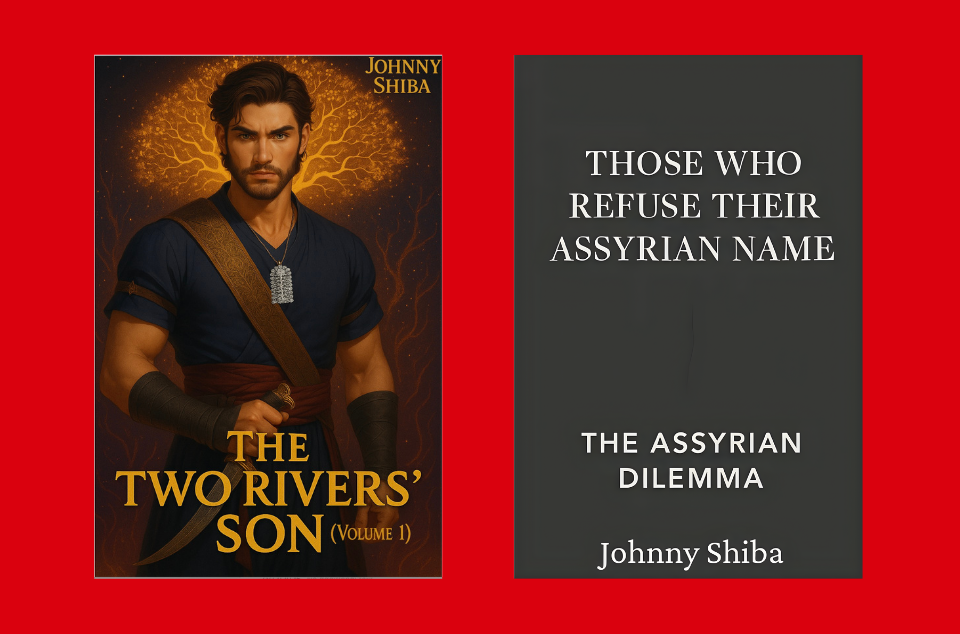
Johnny Shiba, a young US-born Assyrian, picked up writing as a hobby while working toward his bachelor’s degree. He has self-published two books so far: The Two Rivers’ Son, a historical fantasy, and Those Who Refuse Their Name: The Assyrian Dilemma, a discussion centered on identity politics.
"I consider myself an Assyrian nationalist in the sense that I’m deeply committed to preserving our culture, language, and history", he explains. "We’ve survived countless wars, natural disasters, genocides, and relentless persecution. All of that endurance can’t be meaningless."
A Chicagoan, he graduated with a master’s degree in computer science last May, but his mind is equally occupied with thoughts about "..how to rebuild Assyria and make it a strong Christian nation again." Despite being born in the diaspora, he feels a calling to wear the yoke of a dispossessed nation that refuses to give up: "It feels selfish to turn away from those who came before us and dismiss their struggles just to chase a shallow, self-centered life that’s all about the “here and now” and “me first.”
What drove you to write these books?
– My frustration from not seeing any real change for our people in the diaspora or in Assyria. My father lived in the United States for most of his life and has kept fighting for change, but non has materialized. I had written books prior to these two, but I had never truly delved into Assyrian identity in my writing. I realized that I have an innate identity, one that not even 0.1% of people in the world can claim. I realized I had to tap into that. As Assyrians, only we understand the struggles, the pressure to assimilate, but at the same time, wanting to take pride in our culture.
The two books, he says, are intended for everyone to read. The Two Rivers’ Son, around eighty thousand words, leans into the historical fantasy genre. Those Who Refuse Their Name: The Assyrian Dilemma leans more toward identity politics and debate, exploring identity fragmentation and Assyrian history in today’s world.
What response have you received from Assyrian readers?
– Some have told me they feel the book faithfully captures carrying an ancient Assyrian identity into the modern world. I was aiming for a Game of Thrones vibe with a realistic mix of old/middle/modern English dialogue and I’ve been told it feels very authentic, like hearing an ancient people speak in a way that’s grounded in their era but still accessible today.
Name one book written by an Assyrian that you liked.
– I really liked The Sound System of Modern Assyrian, a language book written by Edward Y. Odisho. I agree with many of his points, but something that really tugged at me emotionally was a feeling I deeply related to, which was something he wrote in the acknowledgements section, “This book is a gesture of love to my Assyrian people whose language has served the human knowledge for long centuries. Because I hate to see a language, any language, in danger of extinction…”
– I also want to give a shoutout to another book, but it wasn’t written by an Assyrian author. My favorite book on Assyria of all time is The Might That Was Assyria, by H.W.F. Saggs. It has been my go-to reference. It’s packed with insights on our ancient empire and helped ground the historical elements in my own books. It’s an amazing book of hundreds of facts about the Assyrians, a very insightful history lesson, and a very interesting read in general.
While writing is a hobby for Johnny Shiba for now, he explains he wants to become a full-time author, with dreams of writing, producing, and directing his books into feature films and episodic series. "Imagine how many people would learn about our nation, or even just see the word Assyrian on a Netflix show or movie, that would be something" he says. “Sometimes survival begins with being seen, with a name spoken aloud, not buried in footnotes.”


