

For today’s Turkish leadership, there is an unspoken realization: the policies that once wiped out Assyrians in southeastern Türkiye did not resolve Ankara’s “eastern problem.” They helped create it.
The engineered extermination and expulsion of Assyrians from large swathes of south eastern Türkiye did not produce stability. It created a vacuum, one that was eventually filled by a far more formidable force: a modern Kurdish national movement with territorial ambition, and increasingly, military capacity as well as international backing.
Many areas that were once majority Assyrian, or had a strong Assyrian presence, are today entirely Kurdish. This didn’t happen by accident, and it didn’t happen overnight. Take the entire Hakkari region as an example. Once overwhelmingly Assyrian, it is today fully Kurdish, and an active recruitment hub for the PKK.
Turks and Assyrians have both suffered from Kurdish terrorism for decades and Kurdish expansionism constitutes a serious threat to the very existence of Assyrians and to the territorial unity of Türkiye. Therefore, Turks and Assyrians share a natural interest to counter and contain this threat.
For Türkiye, the threat is obvious. Kurdish advances ultimately challenge Turkish sovereignty over more than a third of the country’s territory. The Syrian war demonstrated just how quickly Kurdish movements can exploit chaos to carve out facts on the ground, and that threat is not receding. It is growing. Ankara is seriously in need of a long term and permanent solution to the threat of Kurdish separatism.
For Assyrians, the threat is even more existential. Kurdish nationalism, as practiced on the ground, has endangered Assyrian survival in a way that neither Turkish nor Arab nationalism ever fully did. Ethnic Turks did not move en masse into Assyrian villages and towns to replace the population. Arab expansion into Assyrian areas largely subsided generations ago. Kurdish expansion, however, continues, relentlessly and unapologetically.
The experience of Assyrians under the KRG since 1991 makes this clear. Land seizures of Assyrian lands multiply while Kurdish leaders speak the language of “brotherhood” and “peaceful coexistence.”
Assyrians and Turks are not fighting, and have never fought, over the same lands in the way Assyrians and Kurds have for centuries. This matters. It explains why Kurdish–Assyrian tensions persist regardless of regime, borders, or international arrangements. This is a land conflict. The Kurds, a conglomerate of nomadic tribes and clans who migrated into the Assyrian heartland from the east, have sought to push out Assyrians, the indigenous population and claim our lands.
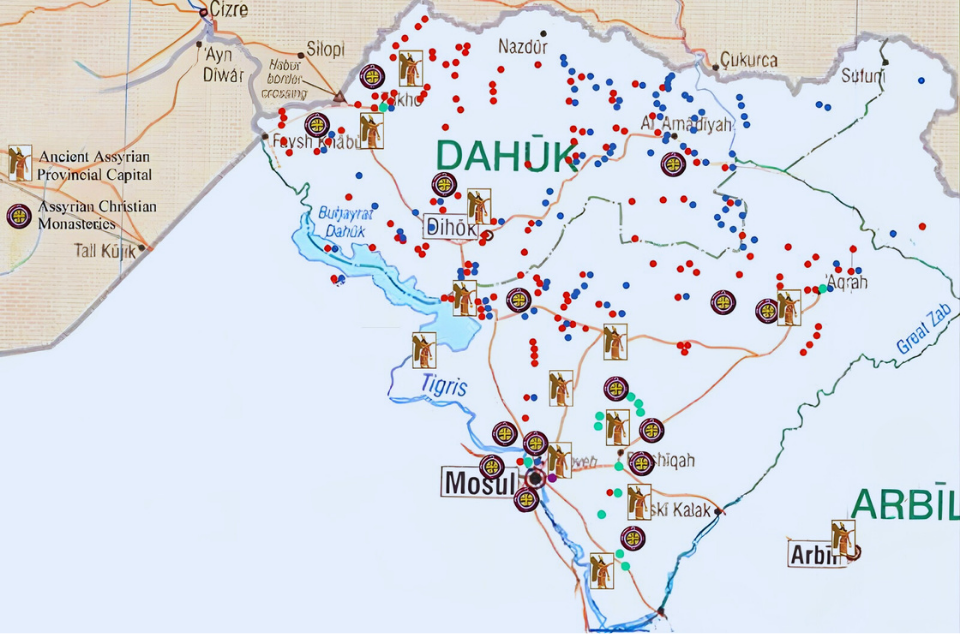
The solution: An Assyrian buffer region
That brings us to a proposal of an Assyrian autonomous region in northern Iraq, ideally stretching along the entirety of the Iraqi–Turkish border.
Such a region would do something no military operation or diplomatic maneuver has managed to achieve, it would permanently dent Kurdish expansionism. It would act as a buffer between Kurds in Iraq and those in southeastern Türkiye as well as severe the land bridge between the remaining Kurdish region in Iraq and Kurds in northeast Syria, disrupting the territorial continuity that Kurdish nationalist movements openly seek.
For Ankara, supporting Assyrian autonomy in northern Iraq would serve two purposes. First, it would be a long-overdue step toward addressing a historic injustice committed against the Assyrian people. Second, and more importantly in realpolitik terms, it would neutralize Kurdish expansionist ambitions in a way force alone never has.
Syria should serve as the final warning. The PKK, under the YPG brand, did not wait for international approval; it moved quickly, opportunistically, and without hesitation once the opportunity presented itself.
An Assyrian buffer region should therefore be in Türkiye’s long-term strategic interest.
Key ingredients needed to make such a region a reality are already in place or realistically attainable with Turkish backing. Assyrians already have strong demographic presence in the Nineveh Plain area and an Assyrian military force, the Nineveh Plain Protection Units, are increasingly tasked with security in the towns and villages there. Assyrian villages and towns dot the entire Dohuk province.
Assyrians were in fact in majority in the Dohuk province up until the 1960's but have since been demographically weakened due to the wars, turmoils and Kurdish demographic engineering.
Once Assyrians gain real authority over land, security, and administration, return will not be theoretical. Assyrians from across Iraq, the wider Middle East, and the diaspora will come back. Not out of nostalgia, but because opportunity, safety, and dignity attract people far more effectively than slogans ever could. Such a region, populated by Assyrians together with Turkmens, Yazidies and other groups would become a beacon of stability on Türkiye's border with Iraq.
Why Türkiye is a key factor
Türkiye is uniquely positioned to help the Assyria Region in Iraq become a reality. Ankara can secure political backing for the project inside Iraq as well as with the US and other important actors. Ankara also has considerable leverage over the Barzani-led part of the KRG as both oil exports and border crossings are crucial for Barzani's survival. Crucially, Türkiye has significant military presence inside northern Iraq. With Turkish political and military backing, an Assyrian force could eventually roll back Kurdish control of the Assyria region of Iraq.
Such a region would considerably diminish the threat of Kurdish separatism both in Türkiye, Iraq and Syria.
Assyrians already play a small but important balancing role in south-east Türkiye (Turabdin region), and northeast Syria. With Turkish backing, they could soon play an important role for Turkish security permanently and irrevocably.
Sometimes strategy and justice briefly align. Ankara should not miss that moment again.


