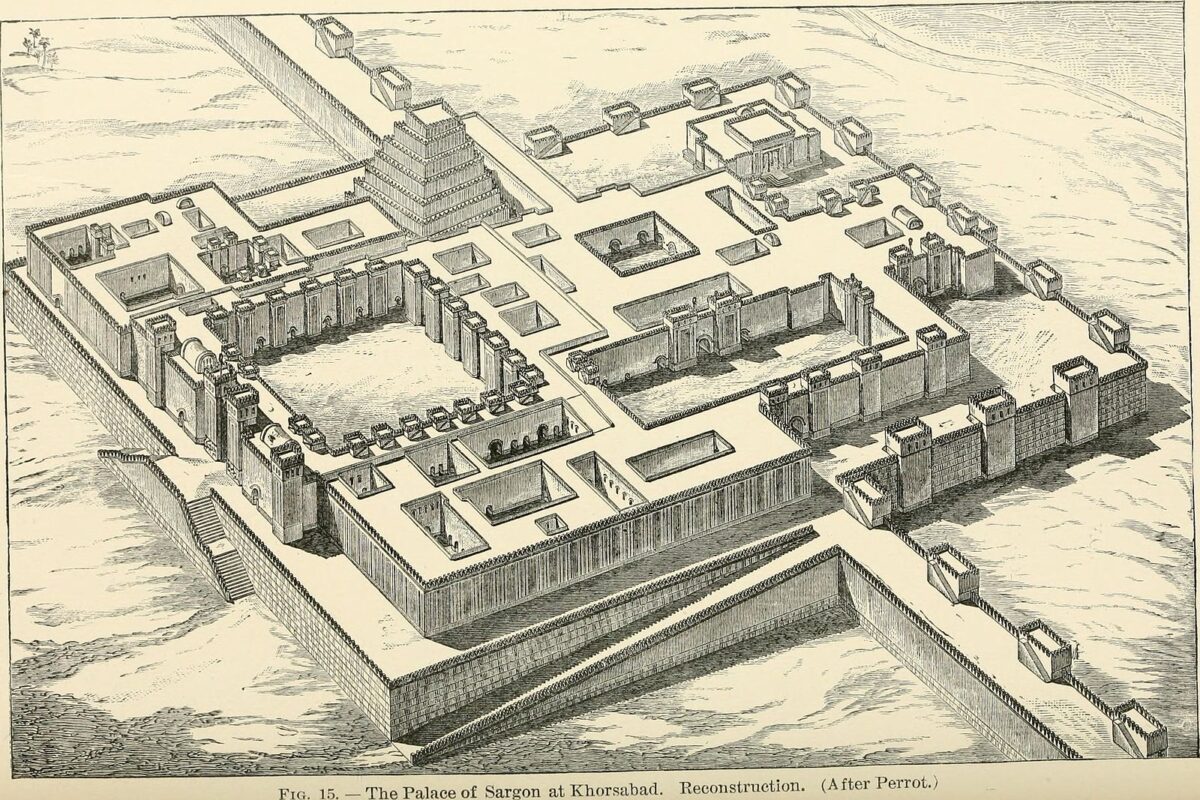
Villa twice the size of the U.S. White House revealed at ancient Assyrian capital
A magnetic survey at Khorsabad, once the ancient Assyrian capital, has revealed the remains of a huge villa (with 127 rooms), royal gardens, the city’s water gate and five large buildings.
"The site, dating back 2,700 years, was originally established as Dur-Sharrukin, or “Fortress of Sargon,” by Neo-Assyrian Emperor Sargon II in 713 B.C.
The Neo-Assyrian emperor Sargon II began building a new capital city, named after himself, in the desert of what is now Iraq. For a long time, archaeologists believed that this ambitious project had only just begun when it was abandoned, leaving behind nothing but the remains of a building site. However, a recent survey of the site challenges that notion. The city did indeed flourish outside the palace, as evidenced by visualizations of data from a precision magnetometer that reveal hitherto undiscovered structures and infrastructure inside the city walls.
Sargon II died a few years after work began on Dur-Sharrukin (“Fortress of Sargon”), now called Khorsabad. His son quickly set up his own capital in the city of Nineveh, and for the next 2,500 years, Sargon II’s building project was largely forgotten. In the 1800s, French archaeologists rediscovered the site."
Her name was pressed into clay 4,300 years ago. Her works were only fully translated into English in 2023. Enheduanna, high priestess, poet, and daughter of the world's first empire builder, is the earliest named author in human history. Most people have never heard of her.
Understanding the role that etiquette plays in regulating individual interactions and group cohesion can provide new insights into how and why cultures evolve.
New research suggests a long-overlooked bas-relief in King Sennacherib’s palace in modern-day Mosul, Iraq, destroyed with other priceless artifacts, showed the Temple Mount and Bible’s King Hezekiah
Her name was pressed into clay 4,300 years ago. Her works were only fully translated into English in 2023. Enheduanna, high priestess, poet, and daughter of the world's first empire builder, is the earliest named author in human history. Most people have never heard of her.
A man of Assyrian descent has been taken into custody following a shooting incident on Saturday morning at an apartment complex in West Bloomfield, Michigan, according to a report by Fox 2 Detroit.
Dasko Sherwani, a representative of the Kurdish Regional Government office in Washington, DC, targeted Robert DeKelaita, a prominent Assyrian-American community leader in a public post.


 Leman Altuntaş