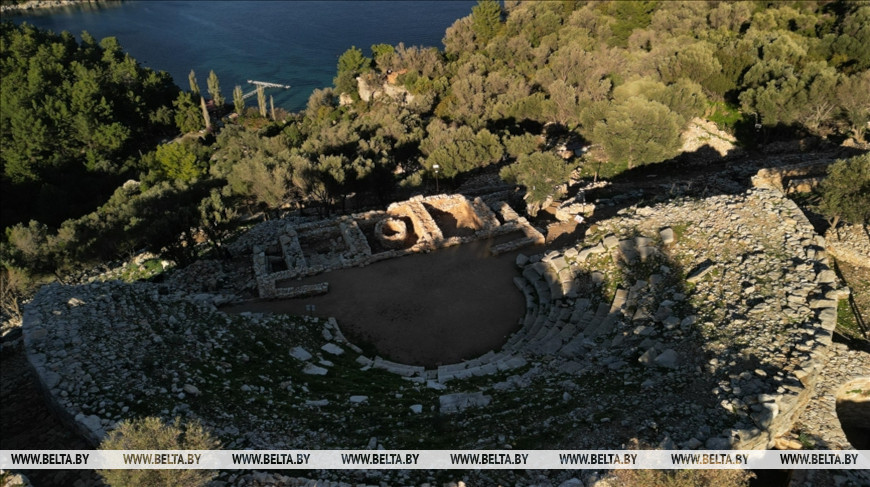
A silver necklace featuring a lion figure and an eight-pointed star, believed to represent the Assyrian goddess Ishtar, has been unearthed during excavations at the ancient city of Amos in Mugla, southwestern Türkiye.
Editor's pick This post is part of hand-picked stories from across the web, curated by the editors of the Assyria Post.
The artifact was discovered at the 2,200-year-old site, located on Asarcik Hill in the Marmaris district, where excavations have been carried out uninterrupted throughout 2025 under the leadership of archaeologist Mehmet Gurbuzer from Mugla Sitki Kocman University.
Gurbuzer told Anadolu that each excavation season brings new and exciting discoveries, noting that this year a silver necklace depicting the Assyrian goddess Ishtar, featuring a lion figure and an eight-pointed star, was uncovered.
He said the find, associated with Ishtar, known as “Inanna” in Sumerian culture, indicates that Amos once possessed significant cultural, economic and commercial power.
The ancient leather armor, datable to 786-543 BCE, was originally made of about 5,444 smaller scales and 140 larger scales, which, together with leather laces and lining, had a total weight of 4-5 kg.
Taking its name from the Assyrian word for “peace,” Shiluh is Turkey’s largest commercial Assyrian-style winery. It is based in Midyat, about 100 km from Mardin in southeastern Turkey, and carries on the winemaking tradition of Christian Assyrians in a modernized way.
We think of ancient civilisations as operating very differently from the way our economy works today. Yet the Assyrians, around 3,000 years ago, began the basis of modern capitalism, in a region spanning most of modern-day Iraq, eastern Syria and southeastern Turkey.
A magnetic survey at Khorsabad, once the ancient Assyrian capital, has revealed the remains of a huge villa (with 127 rooms), royal gardens, the city’s water gate and five large buildings.
The ancient leather armor, datable to 786-543 BCE, was originally made of about 5,444 smaller scales and 140 larger scales, which, together with leather laces and lining, had a total weight of 4-5 kg.
Taking its name from the Assyrian word for “peace,” Shiluh is Turkey’s largest commercial Assyrian-style winery. It is based in Midyat, about 100 km from Mardin in southeastern Turkey, and carries on the winemaking tradition of Christian Assyrians in a modernized way.
We think of ancient civilisations as operating very differently from the way our economy works today. Yet the Assyrians, around 3,000 years ago, began the basis of modern capitalism, in a region spanning most of modern-day Iraq, eastern Syria and southeastern Turkey.
The Alqosh Subdistrict Directorate has announced the launch of a large-scale environmental campaign aimed at reforesting Mount Alqosh, in a bid to restore its vegetation cover and transform the mountain into a vibrant green space overlooking the historic Assyrian town.