

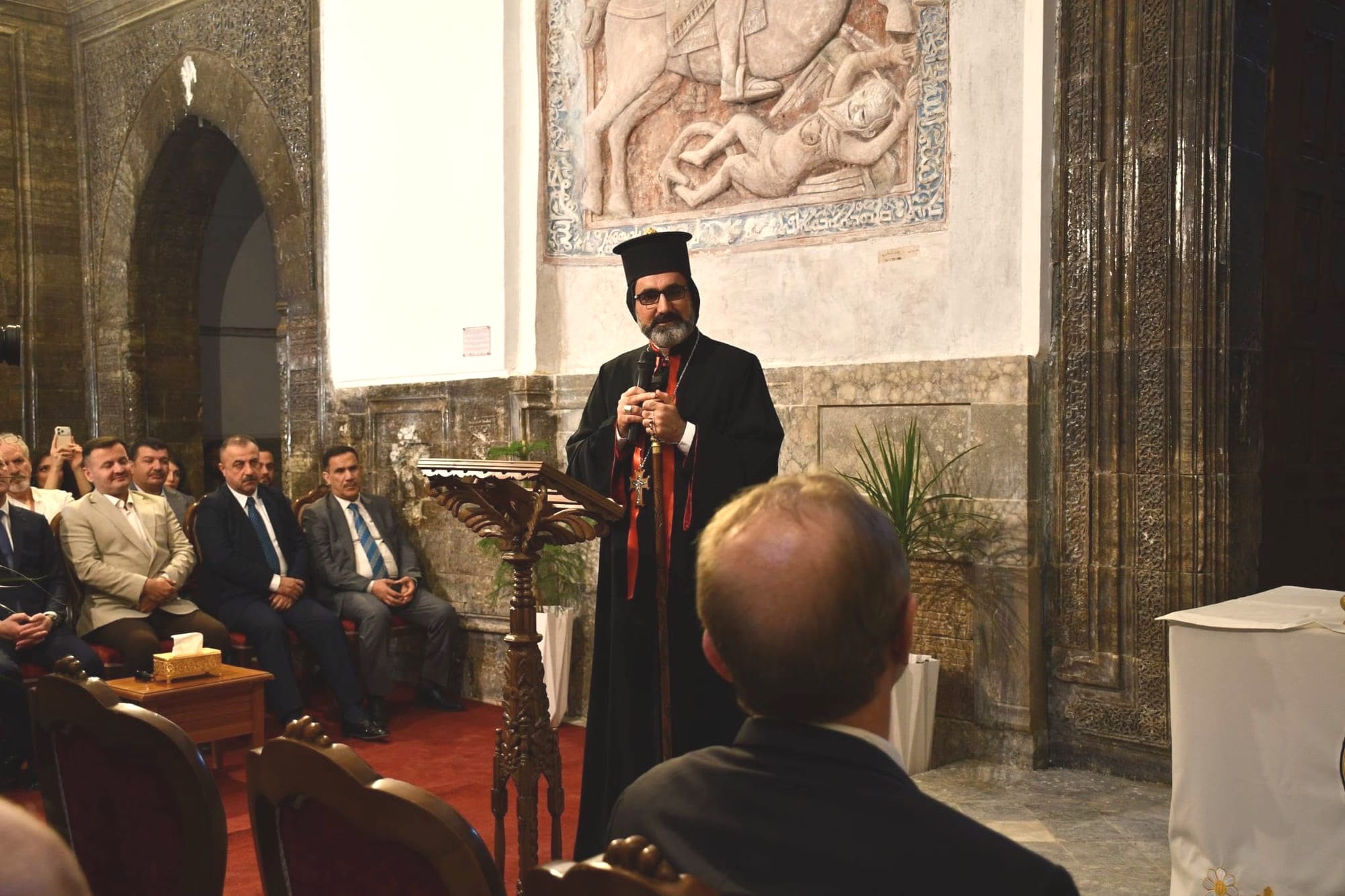
During an emotional ceremony held in the Nineveh Plains near the town of Baghdede (also named Qaraqosh), the local Assyrian Catholic Bishop, Mar Benedictus Younan Hanno, consecrated a newly restored wall relief inside the ancient complex. The intricately carved masterpiece depicts Saint Behnam and his sister, Sarah–two highly revered 4th-century martyrs whose memory has anchored the Assyrian presence in the region for generations. The consecration marks the latest chapter in a monumental, multi-year rebuilding effort spearheaded by local churches and international heritage partners.
Mar Behnam, a vital spiritual and cultural center dating back to the 4th century, had long served as a place of pilgrimage not only for Assyrians but also for local Muslims. This coexistence was shattered in 2014 when ISIS militants overran the region, driving out the local population, transforming the monastery into a base, and blowing up the sacred tomb of Saint Behnam. The monastery's priceless art, including the historic stone reliefs, was defaced or smashed into pieces. Following the liberation of the area, a painstaking reconstruction process began in 2017. While the first liturgical services were held in the partially restored church as early as 2018, specialized artisans and restorers have continued working on the finer architectural and artistic details until today. The newly unveiled relief stands as a visible confirmation that the Assyrian community refuses to be erased from its ancestral homeland.
The revival of Mar Behnam comes amid ongoing reflections on the tragic events of 2014. While the atrocities committed by ISIS are well-documented, local Assyrian leaders and historians emphasize that the catastrophe was compounded by political and military betrayals. Before the jihadists overran the Nineveh Plains, the region’s Assyrian towns were under the security control of Kurdish Peshmerga forces, who blocked any attempts to form independent Assyrian security forces. Local accounts and human rights reports have long highlighted the inglorious role played by these Kurdish forces during the fateful summer of 2014. As ISIS advanced, Kurdish troops unexpectedly withdrew from Assyrian towns and villages overnight, disarming local Assyrian self-defense committees beforehand and leaving the vulnerable population entirely unprotected. This sudden retreat left approximately 100,000 Assyrians with no choice but to flee into the night to escape imminent slaughter.
Today, the survival of the Assyrian people in their ancient Mesopotamian heartland hangs in the balance. Of the 100,000 Assyrians forced to flee the Nineveh Plains during the 2014 onslaught, observers estimate that, at best, only half have returned. Many have emigrated permanently to the West, driven away by economic hardship, political instability, and the trauma of displacement.


