

Developed by Spark Soft Systems, the newly released fonts are said to focus on "clean readability, modern aesthetics, and full Unicode compatibility", making them suitable for websites, publications, educational materials, and graphic design. The fonts support contemporary digital environments while respecting the visual character of the Assyrian script.
Ramsina and Idiqlat: Two new fonts for East Assyrian script style
The developers have named one of the new fonts Ramsina, describing it as a "carefully crafted revival of metal type originally cut in India around 1920, faithfully preserving its historical character while meeting modern typographic standards."
The other font has been named Idiqlat, with the developers writing that it has "undergone substantial redesign to modernize its appearance and optimize performance for contemporary web and mobile environments", adding that the typeface has been "rescaled to align with standard point sizes used in modern fonts and is offered in multiple weights to support a wide range of typographic needs."
The original design of both fonts, created by Esho Marcus has been enhanced with advanced OpenType features developed by Dr Sargon Hasso, Adjunct Professor of Computer Science at the Illinois Institute of Technology. The project was made possible through close collaboration with the SIL Writing Systems Technology group, according to the announcement on the website of Spark Soft Systems.
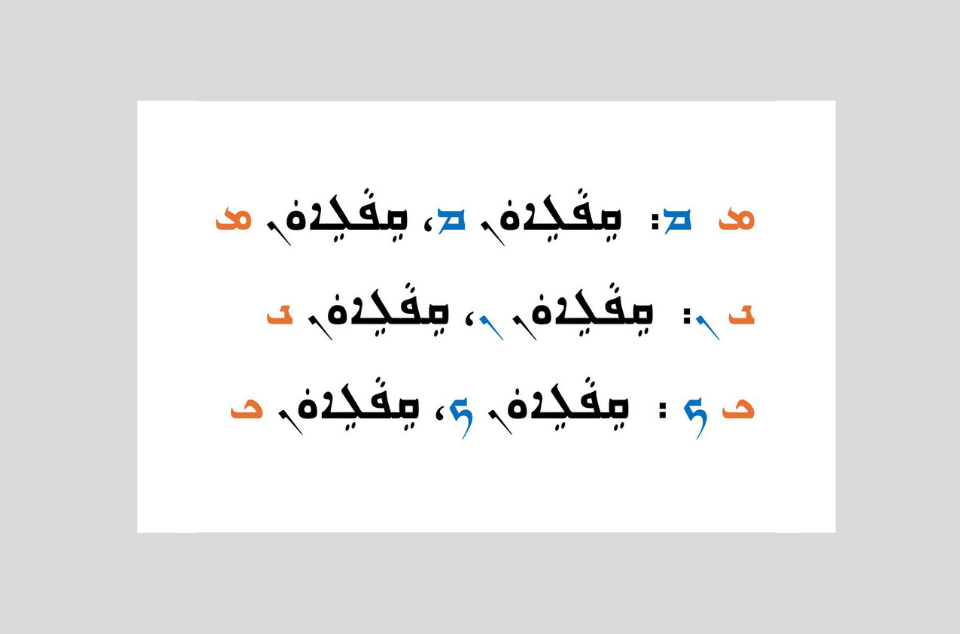
Fine-grained typographic control
These font include advanced OpenType features that enable access to stylistic sets and alternate glyph variants in supported desktop publishing and word-processing applications, including Adobe InDesign, Microsoft Word, and LibreOffice Writer. These features provide fine-grained typographic control and support script-specific variants, such as alternate taw–alap forms in Syriac. Where supported by the application, stylistic alternates can be selected via the OpenType or font feature controls, allowing users to apply contextual, historical, or orthographic variants appropriate to editorial or scholarly requirements.
According to the developers, the fonts were designed to work smoothly across operating systems and applications, addressing long-standing issues Assyrian users face when working with Assyrian text in modern software. The release adds to the still-limited pool of high-quality Assyrian fonts available for professional use.
The collection is aimed not only at native language users, but also at institutions, churches, cultural organizations, and media outlets seeking consistent and reliable Assyrian typography.
The first Assyrian computer fonts appeared in the mid-1980s, created for early personal computers before Unicode standards existed. These pioneering fonts laid the groundwork for Assyrian's inclusion in modern computing systems and eventually in Unicode, allowing Assyrian to be written, shared, and preserved digitally. Today’s modern fonts build on that legacy, ensuring the ancient script continues to evolve in the digital age.
The fonts are available online and can be previewed and downloaded directly from Spark Soft Systems’ website.


