

Known also as Mor Hananyo Monastery, the complex took shape over many centuries, with major additions from the 5th century onward and its present architectural form largely completed by the 18th century.
Its history reaches back beyond Christianity. Official heritage descriptions, church histories, and restoration studies all identify the site as having earlier sacred and military layers: first a pre-Christian sanctuary associated with sun worship, then a Roman fortress, and only later a monastery. In the underground chamber traditionally linked to that earlier cult, visitors are still shown massive stone blocks fitted without mortar and a small opening aligned to the rising sun. Because the public source base is stronger on the existence of this tradition than on a securely published archaeological date, it is safest to describe the substructure as a traditionally identified sun temple rather than to assign it an exact Bronze Age chronology.
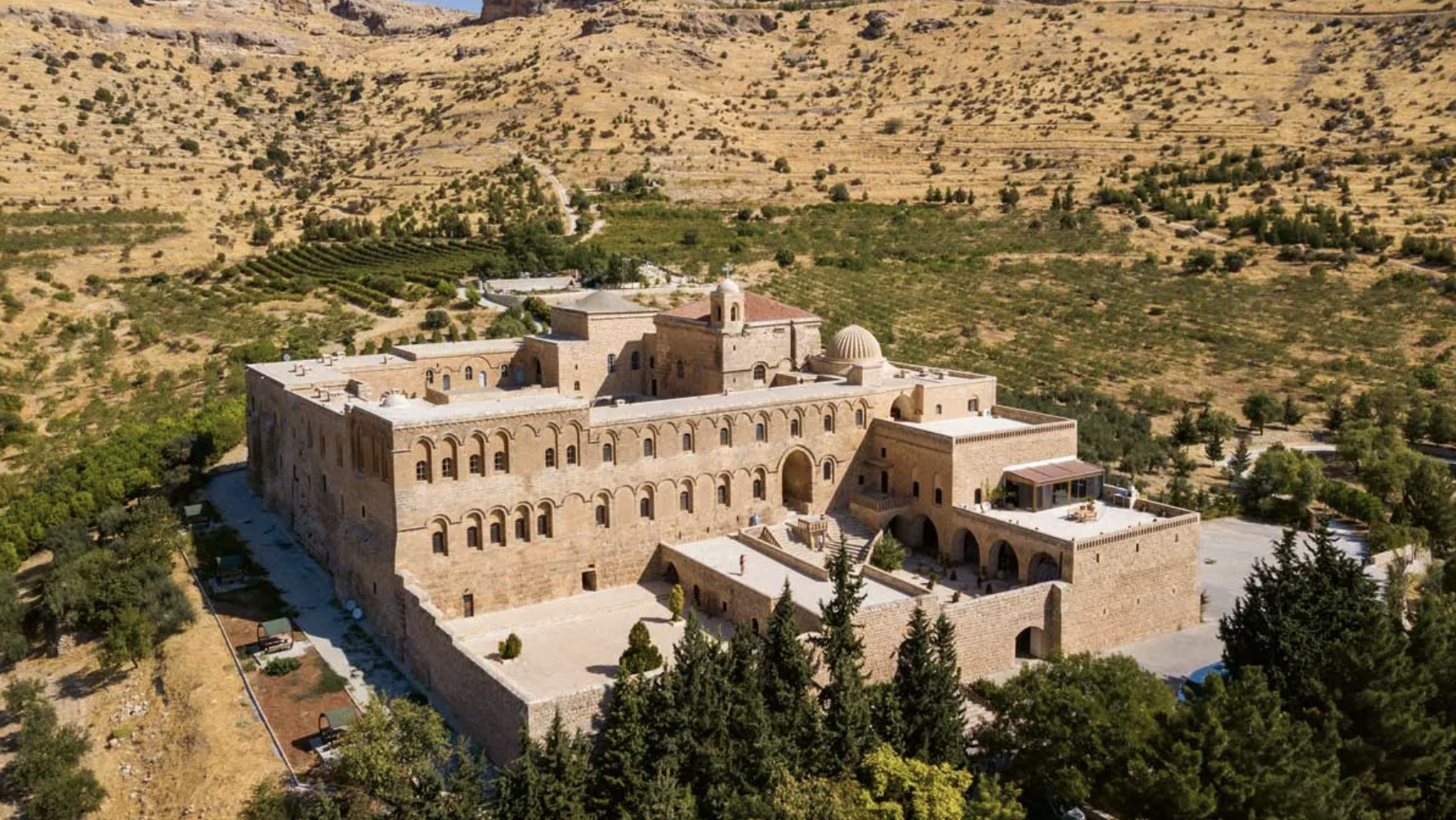
According to long-standing Syriac Orthodox tradition, Mor Shleymun transformed the former stronghold into a monastery in 493, bringing relics of saints to consecrate the new Christian foundation. After a major restoration begun in 793 by Mor Hananyo, Metropolitan of Mardin and Kfartuta, the monastery came to be associated with his name. The designation Deyrulzafaran, or “The Saffron Monastery,” is linked in Turkish heritage sources to the 15th century, but the reason for the name is interpreted in more than one way: some sources connect it to saffron growing around the monastery, while others preserve traditions about saffron-tinted mortar or the warm yellow tone of the stone itself.
Deyrulzafaran became one of the great ecclesiastical centres of the Syriac Orthodox Church of Antioch, to which the vast majority of the Assyrians of Tur Abdin belong. Patriarch Mor Michael the Great was enthroned there in 1166, and church-historical sources describe the monastery as the patriarchate’s best-established seat from 1293 until its transfer out of Turkey in 1932 or 1933. Within its walls stand the churches of Mor Hananyo and the Virgin Mary, as well as the Beth Qadishe, the “House of Saints,” where the remains of many patriarchs and metropolitans are preserved in a seated position facing east, in accordance with the Church tradition.
The monastery was also a center of learning and print culture. Patriarch Peter IV acquired a printing press in England in 1874; it was installed at Deyrulzafaran in 1881, and a dedicated printing house followed in 1882. The first books printed there appeared in 1888, and the press later produced works among others in Assyrian, Arabic, Ottoman Turkish, and Turkish, including the periodical Hikmet in 1913–1914. Printing was interrupted around the First World War and the Assyrian genocide Seyfo, resumed in the Republican period, and under Mor Philoxenos Yuhanon Dolabani the equipment was moved in 1947 to the Forty Martyrs, or Kırklar, Church in Mardin. Publications continued until 1969, while the monthly Öz Hikmet ran until 1953. This made Deyrulzafaran an important regional printing center, though not the first press in the Middle East.
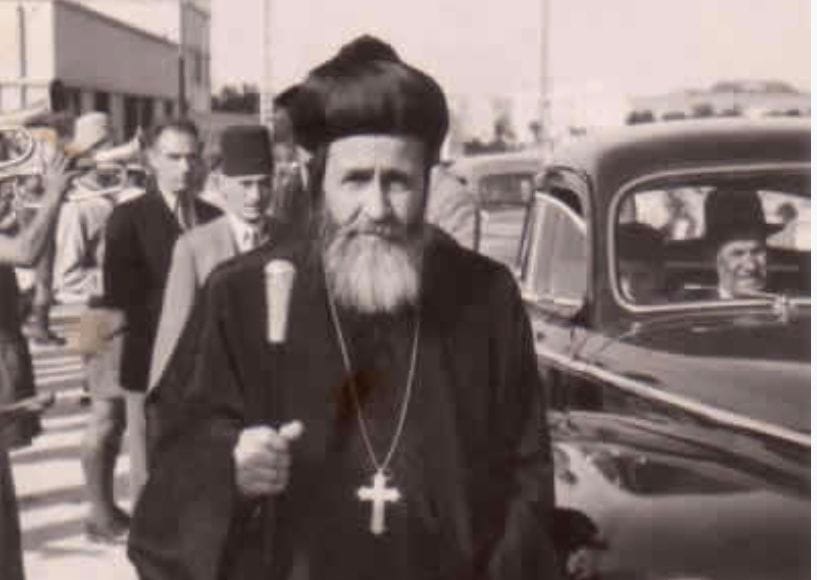
No modern figure is more closely tied to the monastery’s intellectual legacy than Mor Philoxenos Yuhanon Dolabani. He entered Deyrulzafaran as a monk in 1908 and became Metropolitan of Mardin in 1947. A prolific scholar, teacher, translator, and editor, he wrote numerous works in Assyrian, Arabic, and Turkish, helped preserve manuscript culture, and translated liturgical materials into Turkish for Assyrian faithful who no longer understood Assyrian. He is buried at the monastery he served for most of his life. During and after the genocide perpetrated against the Assyrians by Muslim Kurds and Young Turks, Mor Philoxenos Yuhanon Dolabani undertook extensive humanitarian work, particularly focusing on caring for the numerous Assyrian orphans whose parents had been killed by local Kurdish family clans. Regarded as a saint by many Assyrians, the Metropolitan was a selfless servant to his people and his church. Many Assyrians are calling for him to be canonised.
Today Deyrulzafaran is no longer the patriarchal seat, but it remains an active monastery and the residence of the Metropolitan of Mardin. Bells still call the faithful to prayer and Assyrian liturgical language rooted in the ancient Christian East continues to sound within its churches. Layered with memories of pre-Christian rituals, the Roman occupation, monastic scholarship, patriarchal authority and the printed word, Deyrulzafaran remains one of the most significant Assyrian monuments in the Tur Abdin region of northern Assyria.


