

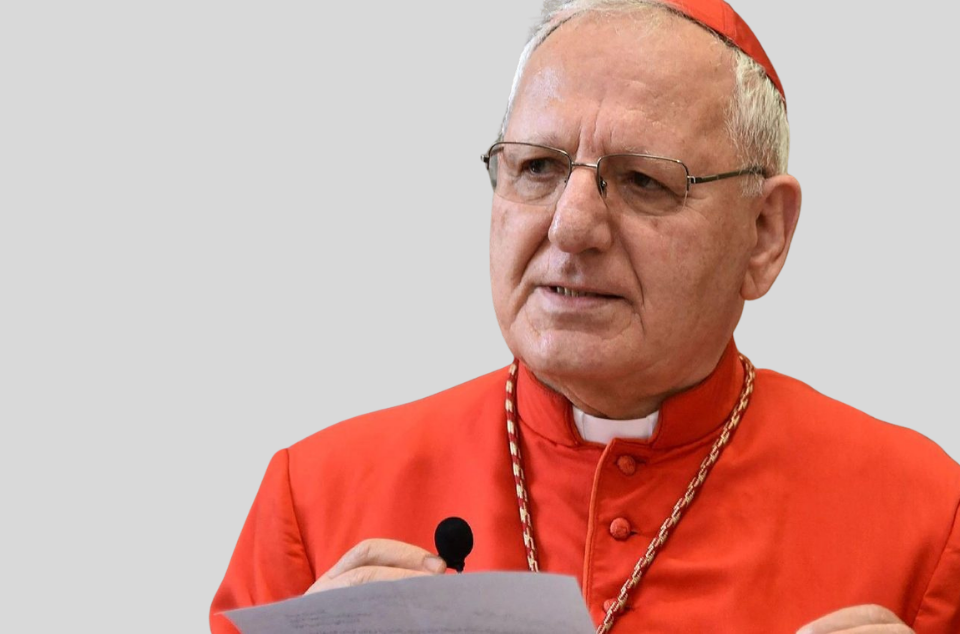
How is it possible—plausible, let alone comprehensible—that a man occupying the office of Cardinal Louis Sako, Patriarch of the Chaldean Church, vested with the aura of sacred authority and adorned with an impressive catalogue of academic degrees, could stand upon a holy altar, under divine oath, and utter what can only be described as anthropological confusion, historical irony, and genealogical fallacy?
This is not a lapse whispered in private, nor an error buried in an obscure footnote. It is a public proclamation, delivered in a sanctified space, before a believing people, in an age where knowledge is neither scarce nor inaccessible. We live in a time when sources, languages, manuscripts, and critical scholarship are available at the press of a button—yet we are asked to accept such assertions as immutable truth, unexamined and unquestioned, as though the modern intellect itself were to be suspended at the church door.
Let us presume—charitably—that the Patriarch and his audience rely primarily, if not exclusively, on the Old Testament. Even under this narrow constraint, one cannot help but ask: how does such a conclusion survive even the most elementary act of reading?
If there is but one source, then let it be read fully.
Let the Cardinal continue—not selectively, not ceremonially—but honestly.
We read in Isaiah 23:13 (Hebrew OT, Masoretic Text):
הֵן אֶרֶץ כַּשְׂדִּים, זֶה הָעָם לֹא הָיָה, אַשּׁוּר יְסָדָהּ לְצִיִּים. הֵקִימוּ בַחוּנָיו, עוֹרְרוּ אַרְמְנוֹתֶיהָ, שָׂמָהּ לְמַפֵּלָה. (ישעיה כג יג)
“Behold the land of the Kasdîm—this people did not exist; Asshur founded it for those who dwell in the wilderness. They raised its towers, they set up its palaces, and he brought it to ruin.”
Even within the very text so often invoked with reverence, the statement is unambiguous: the land and its people are not primordial, not autochthonous, not ancestral in the way later claims insist—but founded by Ashur.
This is not an interpretive stretch. It is the plain reading of the verse.
What deepens the dissonance is the uncomfortable philological reality that the term “Chaldean” itself does not exist in the original Hebrew Bible as a stable ethnic or civilizational self-designation. It is a later anachronism, filtered through translations, hardened by repetition, and sanctified by habit rather than by text. In several ancient and early translations, the same term is rendered with markedly unflattering—and at times openly denigrating—descriptors.And yet, we are asked—implicitly, sometimes explicitly—to accept that an entire ancestry, language, land, culture, and identity descend from this unstable terminology, rather than from the civilization that the text itself names as the founder.
Is the Cardinal truly prepared—academically, historically, and ethically—to stand by such a proclamation?
A child with a rudimentary grasp of history would ask the most basic question:
Where are the cities?
Where are the reliefs, the panels, the tablets, the walls?
Where is the literature, the art, the legal corpus, the architectural footprint, the civilizational residue of this claimed lineage?
Civilizations leave traces. Empires leave scars, monuments, archives, and memory. Identity is not conjured by titles, nor inherited by ecclesiastical decree—it is attested, layered, and preserved through time.
At what point did respect for the intellect of the faithful become negotiable?
At what moment did reverence for truth yield to convenience of narrative?
This is not an attack on faith. It is a defense of reason.
Not a denial of belief, but a refusal to sanctify error.
Not hostility, but accountability.
What a loss—when history is simplified at the altar.
What a shame—when scholarship is invoked but not exercised.
And what a tragedy—when a people are asked to forget what even Scripture itself does not deny.
Finish the verse.


