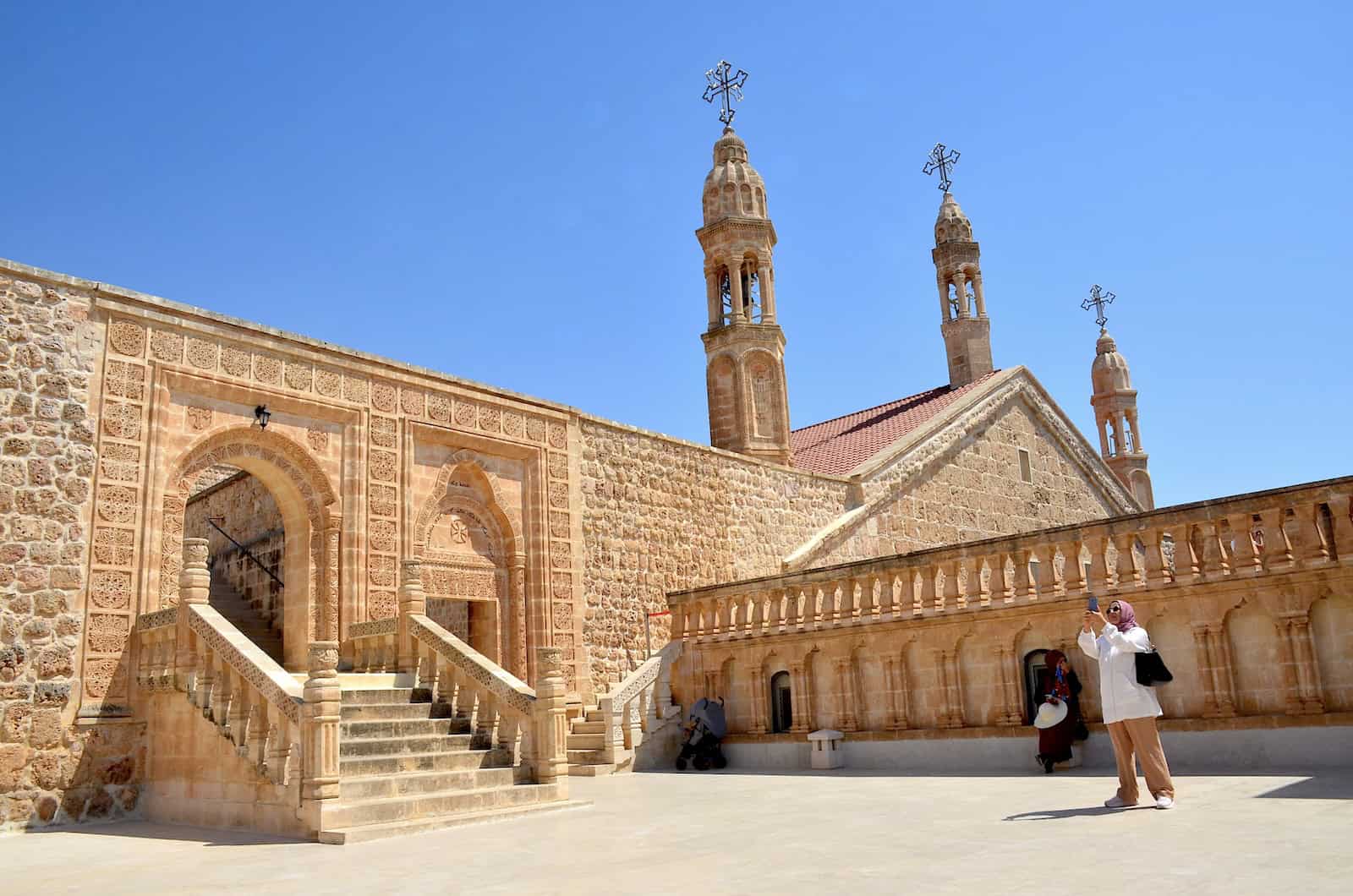
The traveller Nomadic Niko describes himself as a Greek-American originally from Northwest Indiana, just outside Chicago. He visited the Tur Abdin Region in Turkey's Assyrian region recently, documenting his visit in this blog post.
Editor's pick This post is part of hand-picked stories from across the web, curated by the editors of the Assyria Post.
"Before the Assyrian Genocide, there were over 100 villages populated by Syriacs and 70 active monasteries. By 1999, only 10% of the original 50,000 Assyrians in Midyat and the Tur Abdin remained, and the number of villages has dwindled to around 30. Most of the monasteries are now inactive.
On a trip to the region, we were fortunate to visit three monasteries. I’ve written about each below and hope to return to see more of the others."
The ancient leather armor, datable to 786-543 BCE, was originally made of about 5,444 smaller scales and 140 larger scales, which, together with leather laces and lining, had a total weight of 4-5 kg.
Taking its name from the Assyrian word for “peace,” Shiluh is Turkey’s largest commercial Assyrian-style winery. It is based in Midyat, about 100 km from Mardin in southeastern Turkey, and carries on the winemaking tradition of Christian Assyrians in a modernized way.
We think of ancient civilisations as operating very differently from the way our economy works today. Yet the Assyrians, around 3,000 years ago, began the basis of modern capitalism, in a region spanning most of modern-day Iraq, eastern Syria and southeastern Turkey.
A magnetic survey at Khorsabad, once the ancient Assyrian capital, has revealed the remains of a huge villa (with 127 rooms), royal gardens, the city’s water gate and five large buildings.
The American attack on Iran is reverberating across the Middle East, with Assyrian areas in northern Iraq already experiencing the effects of rockets, drones, and falling debris, according to multiple local reports.
The ancient leather armor, datable to 786-543 BCE, was originally made of about 5,444 smaller scales and 140 larger scales, which, together with leather laces and lining, had a total weight of 4-5 kg.
Taking its name from the Assyrian word for “peace,” Shiluh is Turkey’s largest commercial Assyrian-style winery. It is based in Midyat, about 100 km from Mardin in southeastern Turkey, and carries on the winemaking tradition of Christian Assyrians in a modernized way.
We think of ancient civilisations as operating very differently from the way our economy works today. Yet the Assyrians, around 3,000 years ago, began the basis of modern capitalism, in a region spanning most of modern-day Iraq, eastern Syria and southeastern Turkey.


 nomadicniko