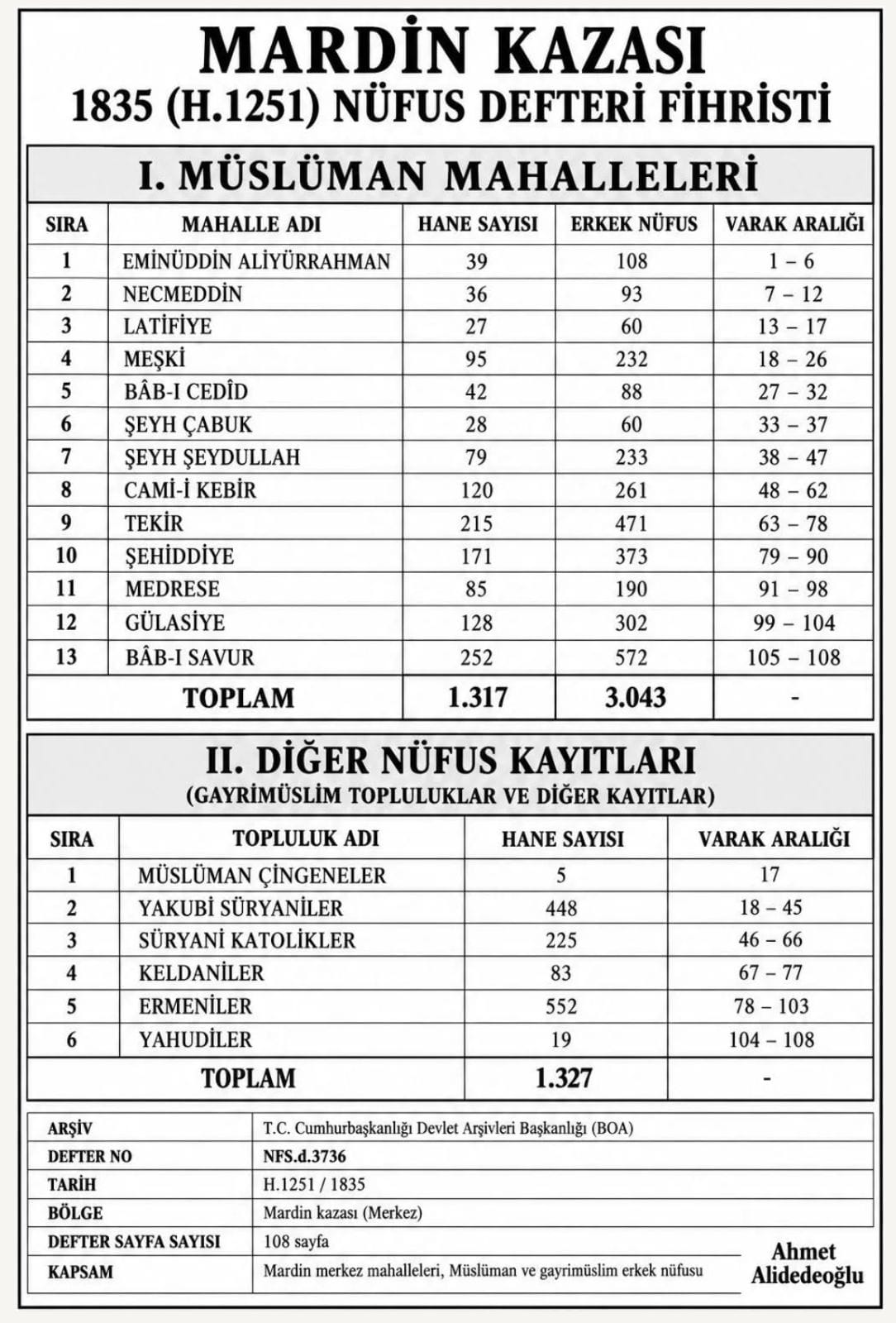
According to the data, the city of Mardin had in the year 1835 at total of 1,322 Muslim households and exactly 1,322 non-Muslim households, showing a balanced demographic structure at the time. The register is kept at the Presidency of the State Archives of the Republic of Türkiye.
The largest non-Muslim ethnic group in Mardin were Assyrians, with 756 households. According to confessional affiliation, the Assyrians of Mardin belonged to the following churches: 448 households belonged to Syriac Orthodox Church, 225 households to the Syriac Catholic Church and 83 households to the Chaldean Church.
In addition to Assyrians, there were 552 Armenian households and 19 Jewish households in the city of Mardin at that time.
Today, in the year 2026, there are approximately 100 Christian households left in Mardin. Almost all of them belong to the Assyrian ethnicity, and the majority are Syriac Orthodox. In addition, there are 10 active churches where services are held regularly. The Syriac Orthodox Church of Antioch conducts the services and takes turns holding services in these churches, including those that were not originally Syriac Orthodox.
The 1835 register remains a crucial source, recording names, fathers' names, ages, kinship and occupations, and allows researchers to trace family histories in Mardin's historic neighborhoods.
Today the city of Mardin has approx. 199'000 inhabitants, overwhelmingly Muslim with a significant number of Kurdish origins.
The destiny of Mardin’s Assyrian population during the 1915 genocide was marked by persecution, mass killings, deportations. Assyrians in Mardin and the surrounding Tur Abdin region faced arrests, massacres, forced displacement, and the confiscation of their homes and property. Many were killed by Ottoman authorities and local armed Kurdish groups, while others fled to the mountains, sought refuge in neighboring villages, or escaped across the borders into Syria. Ancient Assyrian villages, monasteries, and churches were devastated, and many survivors were permanently separated from their ancestral lands. Although some Assyrian communities in the region managed to survive, the genocide profoundly reduced their population and undermined their cultural, religious, and social life.
It is estimated that the Assyrian population of Mardin would be around 100 thousand individuals today if the genocide and ethnic cleansing would not have taken place.