

A leading scholar from the University of Customs and Finance in the Ukrainian city of Dnipro, Professor Dr. Artur Margulov appeared recently on the Assyrian think tank Platform Turabdin to share his extensive research into the harrowing and often overlooked history of the Assyrian minority in Ukraine and the broader Soviet space.
Spanning the early 20th century to the present day, Margulov’s work, drawn from over 20 state archives and five KGB repositories, paints a vivid picture of a community navigating the treacherous waters of cultural self-assertion and state-sponsored repression.
"They did not rush to learn Russian or Ukrainian, as they relied on their own religious leaders and traditions to survive."
Margulov explained during the session that the Assyrian presence in Ukraine began largely as a result of the upheaval during World War I (1914–1918), as families fled from the Urmia region in Iran and south eastern Turkey. Professor Margulov, whose own great-grandfather was shot by Ottoman forces and whose father was born in a Soviet labor camp, noted that these refugees initially viewed their stay as temporary. "They brought with them a tribal and religious system of self-governance," Margulov explained. "They did not rush to learn Russian or Ukrainian, as they relied on their own religious leaders and traditions to survive."
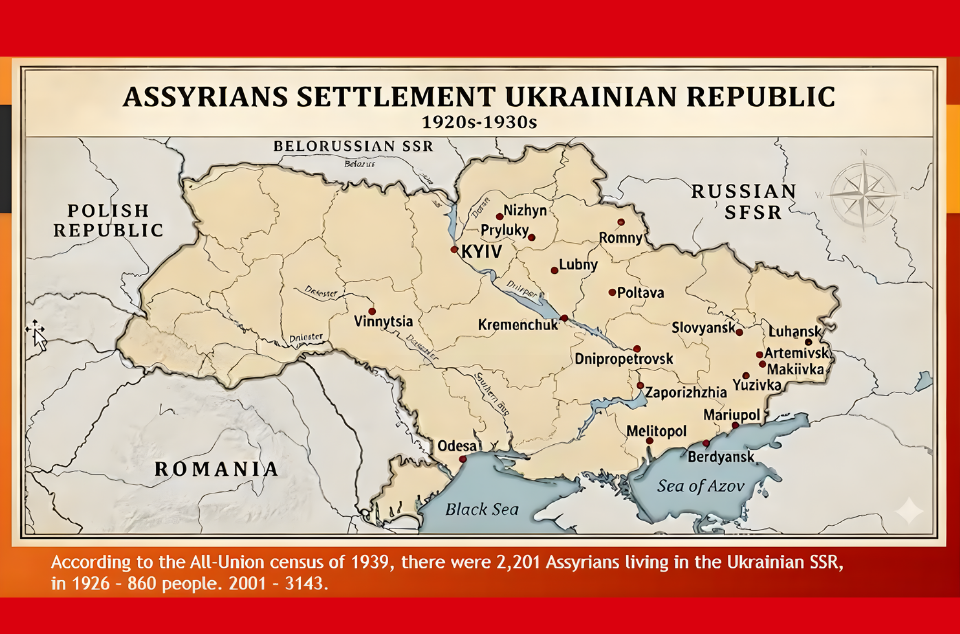
By the 1920s and 30s, the Soviet state began to view this "autonomous" existence with deep suspicion. Margulov’s research highlights a dual identity during this era: while the Assyrian community was developing a modern national identity with its own political parties and literature, the Soviet authorities labeled them as a "dark, patriarchal force."
The 1930s marked a period of intense "Sovietization." The state attempted to Latinize the Assyrian alphabet to spread communist ideology and eventually closed all Assyrian schools, forcing children into Russian-language education. The repression peaked in 1938 when the NKVD, the Soviet Union’s internal security and secret police agency, targeted Assyrians under the guise of persecuting "Persian subjects." Margulov presented chilling archival evidence of Assyrians being executed for "illegal border crossings" or simply for belonging to the intelligentsia.
Today, the Assyrian community in Ukraine faces a new set of challenges. The ongoing war has physically divided the community between those in Ukrainian-controlled territories and those in occupied zones. Culturally, the impact of decades of Soviet assimilation is evident. "The fourth generation has almost entirely lost the language," Margulov lamented, though he noted that cultural hallmarks like the Kha b-Nisan (Assyrian New Year) and traditional dances still offer a sense of unity.
Professor Margulov is currently preparing an English version of his monograph to ensure this history reaches a global audience. "History tells us how identity is shaped under pressure," Margulov concluded. "There is still much to be made visible that would otherwise remain unseen."


