

"The future of the occupied Assyrian homeland will be shaped by building a clear Assyrian political project grounded in a unifying national vision."
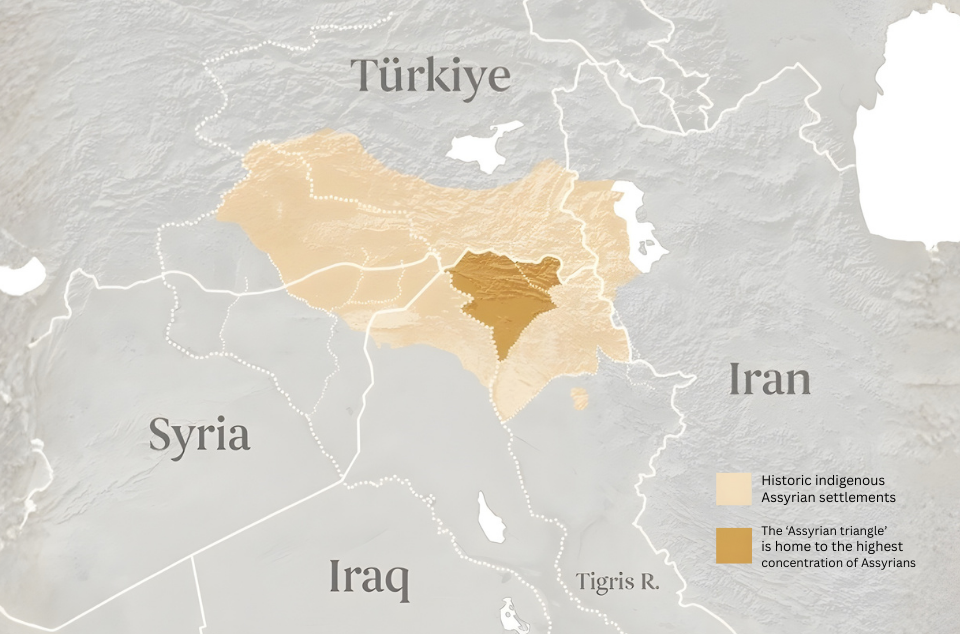
The occupied Assyrian homeland (in its Iraqi portion) represents one of the most sensitive areas in northern Iraq in terms of its geographic location, demographic composition, and deep political history. It forms a direct point of contact between Turkish and Iranian influence, making it an open arena of competition between two regional powers seeking to expand their spheres of influence inside Iraq. At the same time, it remains under the dominance of Kurdish political forces that have imposed their control over the land since the 1990s. Within this complex context, the following analysis examines the regional and local interaction environment by studying the nature of Kurdish relations with neighboring states, understanding the geopolitical interests of Turkey and Iran, and exploring the future of the occupied Assyrian homeland amid escalating regional competition and its impact on the Assyrian people and their historical rights.
A contested space where competing forces clash
The occupied Assyrian homeland emerges as a contested and highly complex geopolitical space due to its strategic location, which makes it a focal point where regional and international interests intersect. It forms a natural junction between Iraq, Turkey, Syria, and Iran, and contains a network of trade routes and military corridors that grant it heightened importance in the national security calculations of these states. Beyond its geographic value, this homeland represents a deep historical and cultural core for the Assyrian people, who have preserved their presence there despite centuries of persecution, displacement policies, and attempts at erasing their identity.
Since 1991, this space has transformed into an actual zone of Kurdish influence, where Kurdish parties succeeded in imposing administrative and security control, benefiting from the collapse of central state authority and from the inability—or unwillingness—of Assyrian political parties to play an effective role, instead becoming tools within the Kurdish system of will and action. This Kurdish expansion, coupled with Assyrian weakness, was accompanied by deliberate demographic re-engineering through land appropriation and the imposition of educational curricula and a political identity that does not recognize the Assyrians as an Indigenous people, but rather seeks to forcibly integrate them into a national narrative unrelated to their history.
This complex reality has left the Assyrian presence trapped between three layers of power operating over their land without regard for their rights or interests: a Turkish regional power with clear expansionist ambitions; an Iranian regional power working to deepen its strategic reach inside Iraq; and a Kurdish power exercising actual occupation of the land and reshaping it to serve its political project. Within this overlap, the occupied Assyrian homeland becomes a contested space where competing forces clash while the Assyrian people pay the price for the absence of international protection and the lack of recognition of their historical rights.

The Kurdish Occupier’s Interaction with Iraq’s Neighboring Powers
Kurdish players deal with Turkey and Iran through a precise pragmatic logic based on what can be described as a “balance of necessity.” They lack the military or political capacity to confront either state directly, yet they understand that their continued existence and control over the land depend on their ability to maneuver between these two regional poles. Through this fragile balance, Kurdish players attempt to exploit Turkish–Iranian rivalry to strengthen their influence within the occupied Assyrian homeland and consolidate a political reality that serves their national project.
The Turkish Dimension
Turkey views Kurdish political forces as a direct security threat due to the affiliation of some factions with the PKK, a group against which Ankara has waged a decades-long conflict. Yet the relationship between the two sides is not entirely confrontational; it is marked by significant pragmatism. Kurdish presence rely on Turkey economically through border crossings, trade, and energy, while Turkey benefits from their presence as a geographic and political buffer preventing the emergence of a unified Kurdish entity along its southern border.
This Turkish advantage is rooted in the fact that Kurdish authorities in Iraqi Assyria seek to monopolize regional Kurdish leadership and do not wish to see a competing leadership represented by the PKK or its historic figures. This internal Kurdish rivalry naturally fragments the Kurdish political landscape, a division Ankara exploits to deepen fragmentation and prevent any unified Kurdish national project that could threaten its national security. Thus, the occupied Assyrian homeland becomes part of a broader Turkish strategy aimed at regulating internal Kurdish balances while allowing local Kurdish forces to control the land in exchange for security and economic cooperation that serves Turkish interests.
The Iranian Element
Unlike its tense relationship with Turkey, Iran treats Kurdish playyers as actors that can be contained through political and economic influence rather than as direct threats. Over the past decades, Tehran has succeeded in building strong relations with certain Kurdish parties, benefiting from their need for local allies inside Iraq to counter Turkish and American influence. Iran invests in this relationship as a means to reinforce its political presence in northern Iraq and ensure that Kurdish players remain within its sphere of influence, whether through economic support or security networks.
Tehran views the occupied Assyrian homeland as a sensitive area through which it can regulate local balances. Kurdish influence there allows Iran to maintain a presence in the Iraqi political landscape without direct territorial administration, by leveraging Kurdish influence within the Iraqi political system and directing it in ways that reinforce Iranian preferences (such as voting on positions like the Iraqi premiership, passing or obstructing legislation, and similar examples). Iran also believes that any move granting Assyrians a special legal status or international recognition could reshape the political map of northern Iraq in ways that may not serve its interests. Therefore, it is wary of the emergence of any independent or internationally protected entity in the region—including any Assyrian project—so as not to disrupt the status quo that has benefited Iran thus far. It also fears that such a project could become a foothold for rival powers or a model encouraging other groups to demand similar rights.
Thus, Iran’s position is based on a combination of political containment of Kurdish forces and obstruction of any structural changes that might weaken this containment or grant indigenous peoples—including the Assyrians—an opportunity to reclaim their historical role or obtain political recognition that would limit Iran’s maneuverability in northern Iraq.
The Assyrian factor
These dynamics have profoundly affected the Assyrian presence. As a result of the fragile balance between Turkey and Iran and the Kurdish exploitation of it, Assyrians find themselves in an extremely complex situation.
Kurdish players use regional competition to consolidate their occupation of the land, while Turkey and Iran treat the occupied Assyrian homeland merely as a zone of influence, with no regard for the rights or history of its Indigenous inhabitants. Meanwhile, the Iraqi state—expected to be the primary guarantor of its citizens’ rights—is either absent due to institutional weakness or incapable of asserting sovereignty against regional and local powers that surpass it in influence and capacity.
This political vacuum leaves Assyrians exposed to the projects of others and renders their demands for protection and recognition vulnerable to neglect or marginalization. Consequently, the occupied Assyrian homeland becomes a politically “ownerless” zone, governed according to the interests of competing powers rather than the rights of its original inhabitants. Although this land has been the home of the Assyrian people for thousands of years—people who possess a legal and moral right to self-determination—the lack of international and local will to recognize this right threatens the future of their existence and places them before existential challenges requiring the rebuilding of their political tools and reactivation of their role in the regional arena.
Yet the Assyrian people do not enter this
crossroads empty-handed.
The Future of the Occupied Assyrian Homeland Amid Regional Competition
The future of the Assyrian presence depends on three main factors. First, the ability of Assyrians to build a unified political framework. The absence of a general Assyrian political framework within which Assyrian actors operate causes regional and local powers to treat the Assyrian people as fragmented groups rather than a single political entity. Establishing such a framework—one that demands recognition of the Assyrians as an Indigenous people and presents a clear project for Assyrian rights on Assyrian land—is essential for any meaningful change.
Second, the role of the Assyrian diaspora. The diaspora has the capacity to influence international public opinion, pressure Western institutions, and provide financial and political support for projects on the ground that preserve what remains of the Assyrian presence within transparent structures. In the absence of an effective Iraqi state, the diaspora becomes a decisive factor in protecting Assyrian existence.
Third, analyzing and leveraging regional transformations. Turkish–Iranian competition may open new opportunities if Assyrians can present themselves as a neutral and constructive actor seeking stability, or if international powers such as the UN or the EU intervene to support Indigenous rights. However, continued Kurdish occupation and the absence of international will may lead to further demographic and political erosion of the Assyrian presence.
The occupied Assyrian homeland stands today at a highly sensitive historical crossroads, where competing regional projects and unstable local balances intersect, while the Assyrian people remain the most marginalized party despite being the original inhabitants of the land. The homeland is trapped between Turkish and Iranian influence—both treating the region as a sphere of control rather than the home of an Indigenous nation—while Kurdish players impose a new political reality that disregards historical rights and seeks to reshape identity and demography to serve their national project.
Yet the Assyrian people do not enter this crossroads empty-handed. They possess elements of strength that can be activated if political and organizational will is present: a historical legitimacy spanning millennia, a resilient identity that has resisted erasure, a widespread diaspora capable of influencing international opinion, and the ability to rely on the language and principles of international law, which grants threatened peoples legal tools to demand protection and recognition.
The future of the occupied Assyrian homeland will not be shaped by waiting for regional changes that may or may not come, nor by relying on the struggles of major powers. It will be shaped by building a clear Assyrian political project grounded in a unifying national vision—one that transforms historical memory from a narrative of suffering into a negotiating force capable of asserting the Assyrian presence as a political actor rather than a perpetual victim of circumstance.
Despite the gravity of the current moment, it carries the possibility of redefining the Assyrian role—if the Assyrian people can organize themselves, unify their discourse, and employ the tools of strength available to them.


